Monday, July 19, 2021

Bridge of the Week #90-91, Starlight Park Bridges

Northern Bridge

Central bridge


I'm such a bridge nerd, it's always exciting to see a new bridge where there wasn't one before. And now in Starlight Park, in the West Farms area of the Bronx, there are three! Two of them are open, the third not yet, so this post is for the northern bridge (#90) and central bridge (#91).

These bridges are especially nice because Starlight Park is part of a string of parks along the Bronx River intending to clean up the river and to revitalize recreation on and around the river, from Sound View Park up to Westchester County. Starlight Park currently runs from E. 177th St. and Devoe Ave., on the eastern side of the river, to Edgewater Rd. at E. 172 St., on the west side of the river, and on the east side of Sheridan Blvd. (Expressway).

I don't have conclusive stats for the bridges, but they are both pedestrian/bike only, both steel arch bridges, with the arches painted a nice blue. The northern bridge is about 100 feet long, and the central bridge about 150-160 feet. The two bridges seem to have been part of a park reconstruction project completed in 2013, which includes some nice park facilites, ballfields, playgrounds, and a canoe/kayak launch, as well as the recreation path through the park that utilizes the bridges. I had been there years before, when the only access was from a ramp at 174 St., and it could barely be called a park, as I remember it. It was quite grungy indeed. Now it is very nice!

The author on the central bridge
I have discovered that the park also has an interesting history. It once contained the estate of William Waldorf Astor. In 1914 it was leased as Exposition Park, and was the site of the Bronx International Exposition of Science, Arts, and Industries in 1918. Apparently, the exposition was a flop, but the land was converted into an amusement park in 1920 called Starlight Park. (It's amazing how many amusement parks there used to be in New York City, possibly a topic for a future post.) By 1933 the rides had closed or burned down and the park was used for bathing and recreation, as well as for the Coliseum, which held concerts and political rallies. By the mid-1940s the park was condemned, except for the Coliseum, which was taken over by the U.S. Army, and currently still stands as the West Farms Bus Depot on 177 St., run by the MTA. The site became a city park in the late 1950s and as I mentioned recently underwent a major upgrading.

There is a portion of the park still under construction, which includes the southern bridge and an overpass over the Amtrak rail tracks, and the final extension of the greenway that will run to Westchester Ave. Currently, there is a fence on the south end of the central bridge, not allowing you to continue, so for the time being, it is a bridge to nowhere. The southern bridge will be covered in a future post when it is open.

As I said, Starlight Park is part of a string of parks along the Bronx River. Directly to the south across Westchester Ave. is another new park, Concrete Plant Park (site of a former concrete plant), and below that is Sound View Park, where the river meets the East River (or what could be considered the western portion of Long Island Sound). To the north, there is some river access on the western bak between E. Tremont Ave. and 180 St., and a small park on the north side of 180 St., adjacent to the Bronx Zoo. North of the zoo is the New York Botanic Garden, then Bronx Park, Shoelace Park, which contain some bridges I've covered here in previous posts, then on north into Westchester County. Connecting all the parks on foot or bike does require some street sections, but what the city has done to make the river and the area hospitable for neighborhood residents, as well as recreation enthusiasts, is truly remarkable!

Park entrance at Westchester Ave, almost ready

Pathway under construction south of the central bridge


Southern bridge awaiting opening


Sunday, July 18, 2021

Bridge of the Week #45a - Update - Bayonne Bridge


Resuming my blog after a long absence with a much-needed update to my Bridge of the Week series. This is an update to the Bayonne Bridge post, due to the raising of the bridge deck and construction of a new pedestrian/bike pathway.

This is probably the only bridge post I will do that is affected by the Panama Canal. The expansion of the canal allowed larger container ships through, but the bridge roadway had to be raised to 215 feet in order to accommodate the larger ships and to allow them access to the New Jersey shipyards.


Grand opening on Staten Island, May 24, 2019
The old pedestrian pathway on the west side of the bridge was closed in 2013. For six years while reconstruction was underway, there was no pedestrian access to Staten Island. After raising of the roadway and construction of the new pathway on the east side, the new pathway was finally opened to the public with a modest ceremony on the Staten Island side on May 24, 2019, which this blogger attended.


There were about a couple dozen cyclists and runners who crossed the bridge to Bayonne, NJ and back that morning. There are several advantages of the new pathway to the older one. First of all, it's new, with a nice new surface. Second, it's much wider, 12 feet wide. Third, it's on the east side, rather than the west, which allows for a better unobstructed view of New York Harbor, as well as Staten Island, Bayonne, and beyond. The view is really spectacular. The one negative thing I noticed is that it seemed to be a fairly steep incline. But it's not that bad, it still meets ADA requirements.

I couldn't find additional stats on the new pathway, but according to my watch, it's just over a mile and a half long from entrance to exit.

Being a Port Authority bridge, it is closed from midnight - 6 a.m. The Staten Island entrance is now located at Trantor Pl., just north of Hooker Pl. The Bayonne entrance is at John F. Kennedy Blvd. between W 6th and W 7th St.

View of New York Harbor
Bayonne, NJ entrance

Monday, August 21, 2017

East Bound and Down

  "East bound and down, loaded up and truckin'
   We're gonna do what they say can't be done
   We've got a long way to go and a short time to get there
   I'm east bound, just watch ol' Bandit run"

For many years, one of my running goals has been to cross the USA on foot. At some point, I don't remember when, I thought I'd like to try to break the world record (according to the Guinness Book of World Records) for fastest crossing of the country on foot, held since 1980 by Frank Giannino in a time of 46 days, 8 hours and 36 minutes. I thought the time to try would be in 2018, the year I turn 50.

So along comes Pete Kostelnick, a young 30-year-old, who breaks Frank's record last year by four days, in an astonishing time of 42 days, 6 hours and 30 minutes! I was fortunate enough to meet Pete and run with him on his last day through the streets of New York City. He's a super guy, very cool, very nice, a fellow (former) Nebraskan, and he didn't seem too beat up at all for having run roughly 3000 miles.

But then what am I supposed to do, give up on the record just because it's tougher and seemingly unbreakable? I don't think so. Even though I'll be 50 years old, 20 years older than Pete, I plan to make my world-record attempt at crossing the USA, from San Francisco to New York, starting Tuesday, August 21, 2018, one year from today at 5:00 a.m. PDT. I will then have to finish before 2:30 p.m. EDT on Tuesday, October 2. That will require running 70+ miles per day, depending on the route and actual mileage. This is something I am confident that I am capable of doing, keeping in mind that it will take nearly everything to go right for it to happen.

It will also take a lot of support both from crew and from sponsors, as it won't come cheap. I will have to do heavy sponsor searching and fundraising, so anyone reading who would like to help, please feel free to contact me.

It's a lot of work ahead, both in physical training and in planning and coordinating. I've told a number of people of my plan, but now I'm making it public, and it scares the hell out of me in a way, but it is the Year of Courage after all, and the excitement is already taking hold. I'd like to thank Pete for encouraging me in my attempt (I think you encouraged me, didn't you?) as well as another man I'm proud to call my friend, Marshall Ulrich, who made his own cross-country run in 2008. I plan to study both of their runs closely to determine the best approach for me.

So there you have it, step one! I will set up a facebook page and a web site for this soon, so I hope you will all follow along. Till then, I've got other races to run, I'll see you all out there somewhere I hope!

Tuesday, January 17, 2017

King of Fear/Year of Courage

I consider myself the King of Fear. At one time or another in my life, I’ve been afraid of just about everything. When I was four, I was afraid of thunder and lightning. Now I love a good thunderstorm. At five I was terrified of street cleaners. If I saw one, I’d immediately run screaming and crying home before I got run over and chopped into a million pieces. I’m happy to say that I’ve overcome those fears, and many others. I’m still not too crazy about being in the water, and high places manage to give me the heebie-jeebies, although I did successfully jump 14,000 feet out of a plane last year. So, at the beginning of this year, I declared 2017, for myself at least, to be the year of courage. It will be the year to push myself out of my comfort zone to discard as many of my fears as possible.

Honestly, having always been a very shy person, my greatest fears have always been certain types of personal interaction, especially if they required me to initiate the interaction, or if it involved any sort of confrontation. And there have been what I call milestones of fear that I've had to face that really just made me shake. There was the terrifying moment the first time I asked a girl out on a date (and got shot down - you know who you are!). Then years later there was the exponentially more terrifying moment the first time I asked a guy out on a date (shot down again!). There were the times I had to be harsh with people when required. But certainly living in New York City for over 22 years has been very beneficial, absolutely requiring so many types of interaction on a daily basis, forcing me to overcome many of my fears.

One type of confrontation I've always been afraid to engage in is political arguments. Over the course of 30 years as an adult voter, I've seen and heard a lot of things that I haven't liked or agreed with, some things even that were downright indefensible. But I held my tongue to avoid confrontation. It's so much easier to get along that way. In that time, many of my views, political and social, have changed, many have not, and society's norms have changed as well. I've usually been able to roll with it all.

But what will happen in just a couple days puts another fear in me that will require me to stop holding my tongue, to speak honestly for the months and years ahead. I don't fear for myself, really. I'm an American-born, white Christian male with a job, good health, and health insurance. I'll be fine. I worry for those who are not white, Christian, employed, healthy, insured men, because everyone outside of that bubble is in danger of losing their opportunity, their money, their voice, their freedom, or potentially more. What I see from this individual we have elected to lead our nation is nothing good, but only judgement and immature insults and condemnation, and the appeal not to our courage, but to our fears. I also see way too much of it from our other government leaders. I also see it from those who support this man. I also see it from those who oppose this man. So stop it. Stop the stupid fear.

Remember, I'm the king of fear, I've been there, I've experienced it, I've lived it. I know what it looks like, I know what it sounds like, I know what it smells like. You have it. I have it. Recognize when it is unwarranted. If you are claustrophobic, don't start ripping the walls apart, because they are not actually closing in on you. There are definitely some situations and actions and words that must be condemned, that are indefensible. But the larger the group of people you condemn, the less likely they are to deserve it. Solving the problems in our world requires the abandonment of this fear, it requires that we not fear and condemn, for example, undocumented workers, or Muslims, or those who live in violent neighborhoods, but rather look at the complex economic, political, social and historical issues that bring about problems in the areas where the problems exist. It's the same way in which solving the problems in our own personal lives requires that we lose our personal fears as well.

So I will call on everyone to make this their year of courage, to overcome your fears to find solutions to problems. This is required of all of us as citizens, and it takes a conscious effort. This doesn't mean the courage to shout louder than anyone else, that requires no courage at all. Have the courage to learn (that damn "L" word again!) - this means everyone! Have the courage to own and admit your mistakes. Have the courage to step outside your bubble. Have the courage to listen, respectfully. Have the courage to speak and express, respectfully and responsibly. Have the courage to write your own words, perhaps even in the form of complete sentences and paragraphs, instead of reposting a meme, even at the risk of public criticism, which might even be deserved. At the risk of failure, try. Be better than our leaders, because you are. Aim higher. But stay away from street cleaners. Happy 2017!

Wednesday, February 10, 2016

Race Report: Skydive Ultra


Trying to get back to my blog, what better opportunity than a race report on one of the most unique and inspiring races in ultrarunning, the Skydive Ultra, which was held this year on Jan. 30 in Clewiston, FL at the Skydive Spaceland. I have always had a fear of heights, and to combat that, skydiving is something that I've been wanting to do as long as I can remember, at least my entire adult life. So the chance to combine a skydive with a 100-mile race, especially when hosted by Eric Friedman, one of the great adventurers and philosophers in ultrarunning, was too much to pass up.

This was my very first trip to Florida as well. I flew into Ft. Lauderdale, picked up my rental car and took a quick trip to the beach before heading to Clewiston Friday afternoon. I forgot how blue the water can be down this far south.


The Race

I'll talk about the race first, although it took place after the jump. The course is a 7.25-mile loop that I would repeat 14 times for 101.5 miles. The start/finish was on the road right in front of the skydiving facility where they had a well-stocked aid station, portapotty, and plenty of parking along the road to self-crew from my car. The course was flat, mostly sand and grass doubletrack service roads through the surrounding sugar cane fields and alongside irrigation canals. Most of the fields were empty but there was some tall sugar cane in a couple of the fields we passed, which made me wonder, do they need to detassle sugar cane? There had been quite a bit of rain in the area recently, which made the sand hard-packed and an excellent running surface, but left some muddy areas in the grass, including one sizeable and unavoidable mud puddle, which maybe added a pound to each shoe by the end of the race. There was also a second aid station about three miles into the loop with fluids, fruit, broth and some very friendly volunteers.

The event encompassed a wide range of possible distance options: 10K, half marathon, marathon, 50K, 50 miles, 100 miles and 150 miles. Just to not go too crazy I decided to sign up for the 100 miles, although if I go back, I might have to do 150 to get that big-ass buckle! Any of the runners have the option to skydive or not. Due to the nature of the event and the uncertainty of the time required to do the jump (the jump is not timed and not technically part of the race), all runners don't start at the same time, but are chip-timed from whenever they cross the starting line. I started at about 9:20 a.m. Saturday with one other runner, Cortland Wheeler, who jumped from the same plane as me.

Early on, I was trying to get over the effects of the jump, get my legs and my head back down to earth. But I was moving well and enjoying the beautiful day. The course was not especially scenic, but I was enjoying the tall sugar cane, the company of other runners and race staff, and the recurring sight of other jumpers falling from the sky. Going in, I didn't feel well-trained for a really fast 100, and my legs were feeling it after a few loops, especially with the muddy feet. The grassy sections had "sweet spots" that were smoother and easier to run, but stray from those and the ground was more uneven and harder on the wet feet, accelerating the blistering process.

All through the race I had no idea if there were any runners ahead of me, but I didn't worry about it too much, as I didn't go down there with competition as my main goal. I don't recall any other runners passing me (except one, but he was pretty darn fast, so I figured he was running a shorter distance), but it was also a pretty big loop so there could be other runners at roughly the same pace. The course record was over 20 hours, and I was planning to get under 20, so that was what I was aiming for, especially after the halfway point when darkness came and I slowed down more. I realized I really am a trail wuss - I like smooth road surfaces and I hate wearing a headlamp!

Throughout the second half of the race I could feel more and more blisters forming, and it became quite painful. Any slight misstep onto a rock or the wrong part of a tire rut would bring an "ow" from my mouth. And I was losing energy, but the key is to keep for and technique. So I would lift my head, keep my back more straight, get good breaths, keep my feet aligned straight and I would get back to a decent running pace. All the while I kept counting down the laps, thinking how many more times I had to make that awkward turn, or run that long section along the highway, or of course run through that mud puddle.

So finally after 13 laps and just one to go, Eric says it'll be close with Michael Peragine, who apparently had started before me and who had already finished, but who I don't think I saw at all during the whole race. There's always reason to finish strong, but I also don't particularly enjoy the stress of knowing it will be a close finish with someone who'd already finished, especially since I didn't know if he had the advantage or if I did, and how close. I could handle losing by five or 10 minutes, but I don't think I could handle losing by 5 or 10 seconds. In the end, I crossed the finish line in 19:55:42, all things considered happy to get under 20 hours and under the old course record. But I didn't get under the new course record as Michael finished over an hour faster, it wasn't that close after all. It's all good, I was actually glad that it wasn't that close. And even if I'd known, I wouldn't have been able to beat him on that day, so I was happy with my second place and an unforgettable adventure.

The Skydive

So with 47 years of anticipation of my first skydive, once I committed to it, I tried not to think about it, lest I freak myself out. Prior to arrival at the race/skydive venue, I was required to watch a video about tandem skydiving and fill out several pages of forms, all of which seemed to mention repeatedly that this could result in my death. Honestly, that didn't bother me. It started to feel real Saturday morning when I got to the hangar and watch the other runners/divers putting on jump suits ahead of me and the little plane with a big hole in the side prepare for boarding. I met my instructor, Jeremy, who was very enthusiastic as he got me suited up and gave me instructions. He was also very good at telling me what to expect and how it was going to go down. So before I knew it, I was in a jump suit and strapped into a harness with an altimeter on my wrist and goggles around my neck. Jeremy was gamely trying to get me psyched up, but I was never one for the adreno-testosterone rock 'n roll hype. (Sort of like dirty talk, I can go along with it even if I'm not really feeling it.) I'd opted not to buy the video/photo package for $99, partly because I was on a tight budget, and partly because the only thing I'd really use it for is a facebook cover photo. But Jeremy had the camera in case I changed my mind after, so he was trying to get me to play to the camera, but I really wasn't feeling it. I was nervous definitely but actually kind of relaxed and zen about it.

It wasn't long after we saw the first group coming down from the sky that the plane pulled in front of the hangar for us to board. From then on it was all business with no time to really think about what I was about to do (although Jeremy was still occasionally trying to get me to get psyched for the camera). There were five pairs of us on the plane, sitting on long cushioned rails as we took off and gradually ascended. I was watching the altimeter rise, and it seemed to take a long time to get to 14,000 feet. On the way up, Jeremy pointed out nearby Lake Okeechobee, and when we could see the Gulf coast and the Atlantic coast at the same time, as well as Miami off in the distance. He'd gotten us strapped together, my goggles were on and we were ready when the red light came on, indicating time to jump! Now it was starting to feel real, as the first instructor opened the side door and out he went with his client. We had to scooch up the rail as the next pair went, and the next. Then it was our turn, and exactly as he described it, with no hesitation, out we went.

It's funny how our brains know things, but at the same time the brain ignores these facts. In skydiving pictures, you see people smiling, giving thumbs up, doing maneuvers and choreography and just apparently happily floating in mid-air. I suppose I was unprepared for the force of air that greeted me upon exiting the plane; it was quite overwhelming. And at times I forgot the instruction to breathe through the nose rather than the mouth, so I would sometimes get a force full of wind down my throat. I did remember the instruction to arch my back and keep my feet back up towards my butt, or my instructor's butt, so we had a proper freefall. But I was tense and my back started getting sore and my breathing felt uneasy and my head felt light. The fields were lying a safe distance below us, and Jeremy still had me do the rock 'n roll thing to the camera sometimes, but I was definitely not in a rock 'n roll mood at that point. Once we left the plane I honestly wasn't scared, but I regret to say that I didn't really take the opportunity to relax and enjoy it, I was more tense and uncomfortable. When the altimeter read 5000 feet I pulled the golf ball handle to release the parachute and it opened perfectly, but certainly with a jolt. Now, gently falling, I could take off the goggles and enjoy, at least if I weren't lightheaded and worried about becoming nauseous. Jeremy started taking us on a few spins, but I had to let him know that wasn't the best idea for me at that point. I did take the toggles to control the chute for a while, which was very cool. But for the most part I just wanted to be on the ground. Soon enough, we were approaching the landing on the field next to the hangar, and I was surprised how on-target we were and how close we were able to get. Apparently due to the lack of wind to slow our approach, we would be sliding in on our butts, which we did on the wet grass. But it was very smooth and the ride was over!

I've had people say I'd feel like Superman when I landed, I'd be on an adrenaline rush that would carry over to the early part of the race. But I was still a little lightheaded for a little while, my heart was beating hard, and it took me some time to process the whole experience. As I ran the race, I was able to put the feeling, the discomfort, into terms that I could relate to past experience and perhaps some of you (especially you New Yorkers) could relate to as well. It felt like I'd been out getting totally wasted and I was trying to get home on the subway, and I just wanted to get home before I threw up or passed out. I immediately came to the conclusion that while I had a great experience and I was definitely glad I did it, skydiving is not for me, and it was certainly a one-time thing. With a week and a half to reflect, I'm now not so sure it was a one-time thing. I want to try again, and hopefully I'll be able to relax and enjoy it more for the incredible experience that it is.


And an incredible experience it was all around. Jeremy and the folks at the Skydive Spaceland managed everything an a very fun, safe and professional manner. Eric Friedman and his volunteers put on a wonderful race, and I made a whole new set of friends in south Florida. Thank to everyone, and you just might see me down there again!

Thursday, August 13, 2015

Race Report: Beast of Burden Summer 100-Mile Run: A Step Back (A Step Forward)

I haven't written a race report for my blog, or anything for my blog, for quite a while, mostly because I haven't had a big race performance that I've felt was worth reporting for quite a while. So if you think I've only got great things happening, just look at how long ago my last race report was.

So I signed up for the Beast of Burden Summer 100 mile race after I had to cancel The Last Great Vol State Ultra, which was held in July, due to scheduling conflicts. I really had intended to stick to 24 hours or less this year, no multidays, as a way of getting back some speed and intensity as a way of being competitive in the 24-hour races again. I'd had a bad and disappointing day at Dawn to Dusk to Dawn 24 in late May, so I was really hoping this 100 could be a stepping stone back to a good 24, and maybe some other good competitive races before I get too old. The race is held on the Erie Canal towpath starting in Lockport, NY. It's 12.5 miles out, 12.5 miles back, four times through, on a flat, smooth, crushed stone surface, great for a fast time. The tough factor is the weather, which tends to be hot and humid in August, and there's no shad at all on the course.

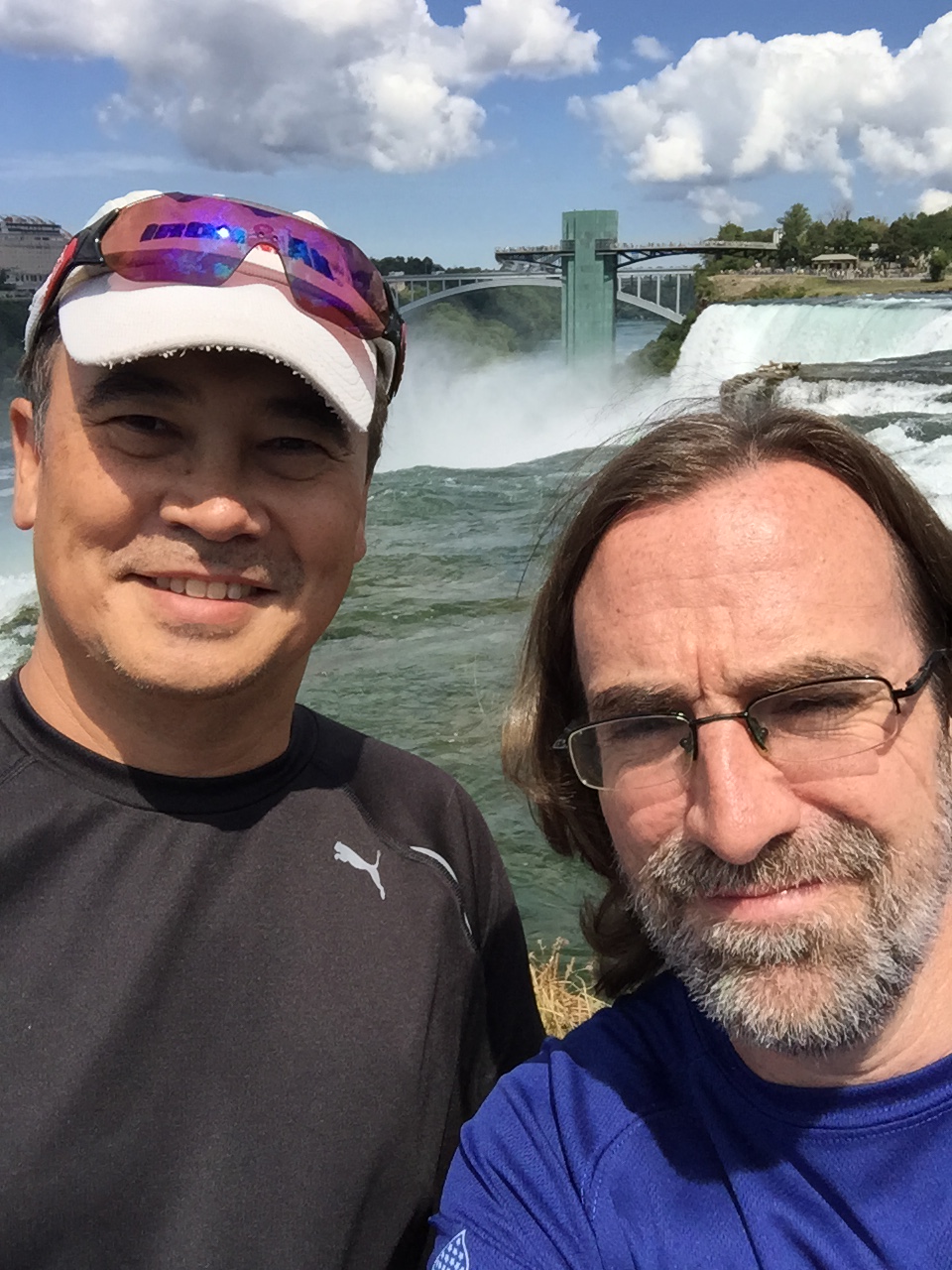
I was very fortunate to get a ride to the race from Bobby Leong, who dropped me off on his way to eastern Ohio for a family visit. He even graciously agreed to take a quick side trip to Niagara Falls (American side), since I'd never been there before! Beautiful! (Bobby also has an awesome playlist on his phone, but that's for another story.

I was also fortunate to have the hospitality of Jim and Beth Pease, who are generous without end and who were invaluable volunteers for the race.

With a 10 a.m. start on August 8, I was able to get a good, full night's sleep before the race and still have plenty of time to set up my things on a picnic table near the start. It was my first time at BoB, but everyone instantly made me feel like family. There were also a number of New Yorkers (City folk) there to help me feel at home as well. And one nice item was that the weather was looking to cooperate nicely, with projected highs in the 70s with cloud cover, and only light winds! With the cooler weather, I opted to carry only one water bottle with me, which would contain my secret special blend of sports drinks, which I was trying here for the first time. One bottle rather than two meant moving faster and slower exhaustion, and I was confident that one bottle could get me through the 7 miles to the first aid station and 5.5 to the turnaround, with refilling at the aid stations.

So off we go, and some of the 50-mile and 25-mile runners took off like a flash. I went out pretty strongly, but on the eastbound outbound stretch the breeze was against us, so I didn't want to push that too hard, but just focus on proper form and technique. I got to the turnaround at Middleport in about 1:45, a little slower than I was hoping, but good enough to keep me in the lead for the 100. With the turnaround, you could see where your fellow runners/competitors were. Previous champion, Steve Parke was close behind me, so there was no slowing down. I got back to the start in 3:31, pretty much the same split. And Steve pulled in while I was there getting food and drink.

On lap 2 Steve caught up to me again at the Gasport aid station (mile 32), so I had to keep up the pace. By now it was getting warm, still not too hot, but the sun was coming out occasionally, and I had decided to run shirtless, which I never do, but it did help keep my body temperature down. By lap 3 evening was coming on, so the shirt was coming on too. Seeing Steve as I started lap 3 it looked like I had maybe a mile on him, still way too close to let up.

I was still feeling good, no problems with the stomach or feet or legs or anything, just starting to get that soreness that sometimes happens after running 50 miles. But I continued to focus on posture, form and technique to keep  me moving smoothly and quickly and to keep my breathing strong. The drink mixture seemed to be working well for me, although I had to take a break from it for 12 miles because the taste (strawberry/punch flavor) was starting to annoy me. But when I went back to it it tasted good again. And getting liquid nutrition helped keep me from spending too much time eating at the aid stations, in fact I ate very little solid food at all, except at least some fruit at each stop, one protein bar that I munched on through the race, maybe some chips, and once or twice some grilled cheese.

Darkness fell as I pulled into the start at mile 75, about 11 1/2 hours in (9:30 p.m.). So I was happy to be keeping a consistent pace, and was hoping to get the final lap in by another four hours and get under 15:30. My real hope was to beat my friend Tommy Pyon's 2014 time of 15:16, second-fastest on the course. So with little time spent I was off again for my last lap.

Jim Pease and me at the finish
I felt comfortable still and felt like I was keeping a good pace, but it's hard for me to tell in the dark. It was also hard for me to tell who the other runners were as I met them, so I wasn't sure where Steve was, so I just kept pushing to do what I could to keep the lead. By now I was becoming familiar with the course, the landmarks along the way, so it didn't feel like just long open stretches until the aid stations came into view. That breaking the course into smaller familiar sections helped keep my mind from getting too overwhelmed. I spent very little time at the aid stations now, just kept the finish line in my mind. On I went, keeping pace as best I could, feeling like I was slowing down but not sure. I was confident I had the win but still wanted to get as good a time as I could. Only in the last three miles did I start to get hungry, and it was a pretty painful hunger. I had just a little bit of Heed left in my bottle, which helped a little, enough to get through. I'm so accustomed to fixed-time races, what a joy it is to approach an actual finish line, and in the lead!! So I finished in 15:27:06, faster on the last lap than I expected! Partly that was due to shorter aid stops. Jim pease and Bobby Leong greeted me there, I got my buckle from the RD and I sat down and got some food in my stomach. Bobby, having returned from Ohio, took care of me well. After about a half hour of rest and refueling and chatting with the RDs and aid station staff and runners who had come through on mile 75, it was time to be off, as Bobby had engagements to keep before we returned home. I was told that Steve had a little trouble and had to take more time at the 87.5 mile aid station. Little did I know that John Boser (who's barely half my age), who I'd seen running strongly all day, had passed Steve and was close to finishing, in just 16:08 for second place.

Me and Bobby Leong at the finish
So that was the race, but there was also the run, the many great things that made the experience truly enjoyable, starting with the people. The other runners, the aid station volunteers were all so great and supportive. I don't chat much when I race, so I couldn't really express how appreciative I was of their kind words and support!

There was also the beauty of the course, the smooth canal and the woods alongside, with occasional houses or small towns along the way. It was especially beautiful as sunset came, and the sky cleared up to give bright colors to the landscape. And at night the occasional fog off the water added an eerie touch which was nice. It was nice to see stars, too, which actually helped me run, as I sometimes tend to slouch when I get tired which hampers my breathing. Looking up at the stars kept my head up and my chest open to aid in my breathing and my form. Plus i saw one shooting star, and I kept looking for more!

So I owe a big thanks again to Bobby, and to Jim and his wife Beth, to the RDs and their staff and volunteers, and to all the other runners, not just at BoB, but all those in the NY ultra community who inspire me and help make me want to be the best I can be.

Sunday, December 29, 2013

Race Report: Brooklyn Marathon

This report is also a couple of months late, but at least it has a happier ending than my last.

Over the summer and fall I had been coaching a good friend from El Paso to run the new York Marathon, his first marathon, and through his experiences I felt a new excitement for the race, as if it were my first marathon again. (My first marathon was the New York Marathon in 1997.) He did very well in the race, I had a lot of friends who ran, either on their own or as pacers or Achilles guides, so I was inspired to sign up for the Brooklyn Marathon on Nov. 17. This would also be my first marathon since Boston 2011, which happens to be my PR at 2:50:55. I'd been wanting desperately to run another marathon but couldn't find on nearby on the calendar that I could run, until Brooklyn. I was also looking to re-qualify for Boston, but this would be too late to enter for 2014. Still, I was ready to go.

This relatively new race, put on by NYC Runs, was run entirely in Prospect Park. According to the web site the course was two loops around the lower end of the park (about two miles each), then 6 full loops (about 3.3 miles each), followed by another lower loop. It might have been confusing for some people, but the logic was there, and there were signs marking each mile, so it wasn't tough to follow. I was very familiar with Prospect Park, since I trained there a lot when I lived in Brooklyn years ago. I figured the big hill leading up to Long Meadow could be tough after a few repeats, but then again there was an equal downhill on the other side.

At the start it felt like a very fun, low-key race, almost old-fashioned, with not too many runners (about 400-500 in the end), no corrals, and in informal chat before the race with some of the expected leaders about staying in the designated lanes of the park road. The park was fully open to the public, but avoiding casual parkgoers was seldom a problem of any kind. The weather felt good, warm for mid-November and overcast, so it promised to be a good time.

I didn't have a firm goal, except to qualify for Boston, but I was hoping to get in under 3:00. I started out at a good pace for that goal, a little fast actually, but that first mile is mostly downhill. I chatted a little bit with a young guy, just graduated from college, who was running his first marathon, and hoping to get under 3:00 as well. We ran together basically for the two short loops and then some before he pulled away. I'm so accustomed to running ultras on loops even shorter than this that the multiple-loop format didn't bother me. There was water and Gatorade at either side of the park, so aid was good. I hit the half marathon mark in about 1:28, so I was still on track for a sub-three, but I'd have to keep pushing. Surprisingly, the big hill didn't seem to bother me as the race went along, in fact it felt like it got shorter, even if it did slow me down a little. My back did start to hurt me after about eight or nine miles, my feet started hurting after about 10, and that rain came down in the second half, but I kept pushing through. With about two miles to go, starting the final short loop, I spotted the young rookie who'd pulled away from me early in the race, and I was slowly catching up to him. So I had to motivating factors, catching him, and getting in under three hours. I was not quite able to catch the guy, but I did get in under three hours, with 2:59:03, good for 11th place, and first in the over-40 age group.

After my disaster at 24 The Hard Way, I needed a good race, so this felt very good. And I was reassured that I still have some speed left. And it was a fun race, a nice community atmosphere, well done by NYC Runs. They are trying to get permission to put the marathon on the streets of Brooklyn, but I really like the loop course in Prospect Park and the small field. This is one I might come back for in 2014.