Monday, November 7, 2022

Olivia Newton-John: Deep Cuts, B-Sides and Rarities


I have been a huge fan of Olivia Newton-John since age 12 in 1980. Her recent passing had a deep impact on me. I wanted to write some sort of tribute, and rather than list my opinion of her greatest hits, since her biggest hits can be found anywhere, and who cares which ones I like more than the others, I decided to spotlight some of the best (my favorite) overlooked and hard-to-find songs that even hardcore fans might not know or know of. So here is a list of 15, because that's how many I felt the need to mention, in chronological order.

1. Would You Follow Me (John Kongos). I haven't yet been able to find out for certain when this was recorded or first released, I have it on a CD compilation of her early songs, 1971-1975, and it's currently available on the recently rereleased deluxe version of the 1971 album "If Not For You." In any case, it's a very catchy, lively, brassy song with a great arrangement and backing vocals, and the earworm refrain of "Lose or win, thick or thin, where would you like to be? Lose or win, thick or thin, would you follow me?"

Would You Follow Me

2. My Old Man's Got a Gun (John Farrar). This is a surprisingly strong country rocker from her 1972 UK album "Olivia," where she warns off a would-be suitor. If you want an early song with a little edge, and to hear premonitions of her later rock style, this is a good song to listen to.

My Old Man's Got a Gun

3. Amoureuse (Veronique Sanson, English lyrics Gary Osborne). This French song was also recorded by Kiki Dee and Helen Reddy among others. Olivia released it on her 1973 UK album "Music Makes My Day." Many of the songs from that album were included on the US release of "Let Me Be There," but this song was left off. It is also on the deluxe edition of "If Not For You". It is a song about a romantic encounter with a haunting, sensuous verse and a more upbeat chorus which features an upward sixth leap as a hook. Very nice all around.

Amoureuse

4. Rest Your Love on Me (Barry Gibb). This song, written by Barry Gibb, was originally recorded by the Bee Gees - as a country song - and released as the B-side to the hit "Too Much Heaven." Andy Gibb and Olivia recorded it as a pop love duet for Andy's 1980 album "After Dark." It was one of two duets they sang together on the album, the other being the hit song "I Can't Help It." "Rest Your Love on Me" was not released as a single, but is a beautiful, sweet, tender love song that features Olivia at her peak of popularity and Andy at the tail end of his.

Rest Your Love on Me

5. Fool Country (John Farrar). This is probably her best-know rarity, from the 1980 movie "Xanadu." It is a two-part medley of a rock song ("Fool") and a stylized country song (I guess they just called "Country"). In the film Olivia sings it near the end as part of the opening-night celebration of the roller-disco club Xanadu. (In the film it opens with an instrumental synth tap number reminiscent of the 1940s, but that is left off the recording.) The song was not included on the soundtrack album, but it was released as the B-side of the #1 hit song, "Magic," and it was also included on the 2-cd compilation "Olivia Gold." The "Fool" section is a nice legit rocker, Olivia being tough with a would-be romantic interest, and the "Country" section is really too synth to be real country, but a simple song telling her man to smile. Both sections apparently try to showcase Olivia's own legacy, both as a country singer and more recently as a rock singer. Interesting to note that when "Xanadu" was reworked and brought to Broadway as a (very hilarious) comedy in 2007, "Fool" was kept in the show, in a different context.

Fool Country

6. You Made Me Love You (James Monaco, Joe McCarthy). This is a real rarity, a well-known standard from 1913 that Olivia also recorded for "Xanadu." In the film, Olivia sings it with a big band in the background as Gene Kelly reminisces about her. The song then goes directly into the lovely duet, "Whenever You're Away from Me." This song was also not included on the soundtrack album and as far as I know can only be found on the B-side to the hit song "Suddenly," which I have a copy of. It's very  lovely, and shows how at at ease and well-suited Olivia is with songs of this era.

You Made Me Love You

7. Falling (John Farrar). This is not much of a rarity, just an incredibly beautiful track from her 1981 album "Physical." Her 1980s albums all seemed to feature one standout slow love ballad, and this I believe is the best of them. John Farrar wrote many of Olivia's original songs, including a lot of her biggest hits, and he often seems to include some really beautiful and creative harmonic progressions. This is a great feature of his songwriting skills as well as Olivia's vocals.

Falling

8. Shaking You (David Foster, Paul Howard Gordon, Tom Keane). This ballad is from the soundtrack from the 1983 movie "Two of a Kind," which reunited Olivia with John Travolta. It is very much a 1980s David Foster song at the peak of his songwriting/producing heyday. It's a beautiful song about the struggles of love, but in my opinion is Olivia's most passionately expressive vocal performance ever. One listen and you can really hear the pain in her voice.

Shaking You

9-10. Big and Strong (Mark Heard), Let's Talk About Tomorrow (John Capek, Amy Sky, Olivia Newton-John). These two songs are from her underrated 1988 album "The Rumour." Olivia didn't always convince me that she could sing legit rock music, but I believe these two songs show that she could, and are backed by a strong rock band, though with an 80s sound. Both are message songs, "Big and Strong" being generally anti-war, and "Let's Talk About Tomorrow" being about environmental protection.

Big and Strong

Let's Talk About Tomorrow

11. Not Gonna Be the One (Seth Swirsky). In 1992 Olivia released a greatest hits compilation called "Back to Basics, The Essential Collection 1971-1992," which featured four new songs, including this one. It's just a great song with a great sound, a classic sound like her biggest late 70s-early 80s hits. Even so, it could have been a hit for her in 1992 if released as a single.

Not Gonna Be the One

12. Tenterfield Saddler (Peter Allen), duet with Peter Allen. This was released on her 2002 album "(2)", a collection of duets with different artists. For "Tenterfield Saddler" Olivia added her vocals to a recording by Peter Allen from 1972. Allen died in 1992, but was a friend of Olivia, and cowrote her signature song, "I Honestly Love You." This is a very tender and poignant song, beautifully done by both Peter and Olivia.

Tenterfield Saddler

13. Anyone Who Had a Heart (Burt Bacharach, Hal David). This song is from her 2004 album "Indigo: Women of Song," in which she reimagines songs previously made famous by other women singers, in this case, Dionne Warwick. It's a magnificent vocal performance and is a real highlight of this album and of Olivia's later albums.

Anyone Who Had a Heart

14. Can I Trust Your Arms (Olivia Newton-John, Chloe Lattanzi) This is a song Olivia wrote the music for, to lyrics that her daughter Chloe gave to her as a Christmas gift. The lyrics display a painful honesty about this particular mother-daughter relationship, an honesty not often heard, and Olivia's music beautifully sets the words. It was recorded for her 2005 album "Stronger Than Before," and album meant to provide inspiration and encouragement to women dealing with cancer, as Olivia of course herself battled and eventually lost her battle with breast cancer. It also features Olivia on the piano!

Can I Trust Your Arms

15. Window in the Wall (Tom Paden, Eddie Kilgallon, Tajci Cameron), duet with Chloe Lattanzi. This is a duet, released in 2021, with her daughter, Chloe Lattanzi, and is a beautiful song about learning to accept other people and finding ways to come together despite differences. It is also one of the last songs, if not the last song she ever recorded.

Window in the Wall

Monday, February 14, 2022

20 Years of Ultrarunning


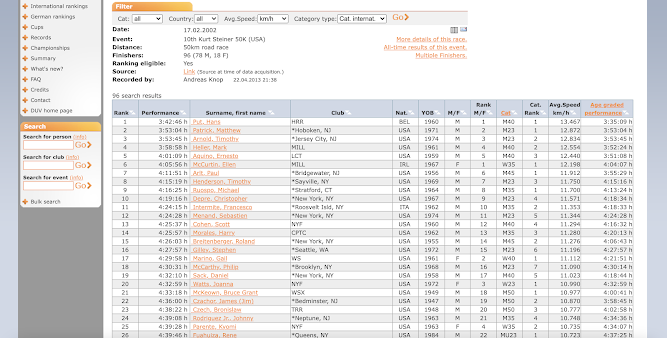
February 17, 2002 is a special date, it was the date of my very first ultramarathon. It was the Kurt Steiner 50K, held by the New York Road Runners Club on the central 4-mile loop in Central Park, held in conjunction with the Metropolitan 50 Mile. Just a few words about this particular race. I'd run a few marathons since my first (New York Marathon, November 1997), and I didn't think I'd get much faster, but I could always go farther. Around that time I was a print subscriber to Outside magazine, and I think that's how I first heard of ultramarathons. So I saw this race on the NYRRC calendar and signed up. I didn't do anything spectacular, but I had a lot of fun, it was a relaxed environment, I remember thinking how cool it was to eat cookies during a race, and it was the first time I met Richie Innamorato, who was race directing on behalf of NYRRC. It should be noted that the Metropolitan 50 Mile race had a long history, going back to 1971. It was the 50 mile national championship for some of those years, and many of the greatest ultrarunners in the early days had taken part, including Ted Corbitt, Park Barner, and John Garlepp.

So began my adventure. In the ensuing 20 years, it's not possible to say in this space how much the sport has affected my life. I've certainly had my successes, and I have to allow myself a moment to list some of my proudest moments, as far as tangible results, only because it all came as a surprise to no one more than me. I have won two 24-hour national championships (2009, 2011), I was the first American man to finish in the top 10 at the 24-hour world championships (2007, 4th place), I set an American record for 48 hours in 2011 with 257.34 miles, which stood for six years, I'm 3 for 3 at Badwater for top 10 finishes (8th, 8th and 6th, 2009, 2010, 2012), and have two Spartathlon finishes in 2016 and 2017 when I was the first American. I'm equally proud of my local success, winning the New York Ultrarunning Grand Prix in 2007, 2010 and 2011, and my three wins of what I consider the toughest race I've ever run, the Pioneer Trek 100-mile three-day stage race, in 2007, 2009, and 2011 (just two weeks after my record-setting 48-hour). Coming full circle, in 2007 I won the final Metropolitan 50-mile race ever held (NYRR removed it from their calendar).

In 2018, at age 50, I decided the time was right to fulfill my long-held dream of running across the USA and attempting a world record. I didn't get the record, but I finished in one of the fastest times ever, in 49 days, 7 hours, 55 minutes, which is still the fastest time of anyone over the age of 40, or 50. It was the adventure of a lifetime.

Like I said, all the success has been a surprise to no one more than me. I was never an athletic person growing up. And all of a sudden I'm semi-famous (in a niche circle) for something athletic, something totally unexpected. It's given me an opportunity to travel around the country and around the world in ways that are much more fulfilling I believe than simply visiting on my own as a tourist.

But what means more to me than the successes in the results is the relationships I've made, the friendships, the people I've met. Music has been and always will be my primary passion in life, but the ultrarunning community in the New York City area, across the U.S. and across the world is the greatest, most supportive group of people I've ever met. My best friends are ultrarunners. We all are intentionally putting ourselves into a great amount of pain for an abstract, unnecessary goal. But we all have a reason for doing it. Some of us are exorcizing demons, some of us are trying to prove something. My own reasons will remain private, at least for now. But we all support each other, we all encourage each other, and we all inspire each other. The result of all this is that I have gained a personal confidence I never had before in my life, helping me to overcome my insecurities and self-consciousness. The sport has very literally in many ways changed my life, for the better.

I've had the opportunity to work as creator and race director for The Great New York 100 Mile/100 KM Running Exposition, which I'm thrilled to see has attracted quite a following, and I'm eternally grateful for all who take part, as a runner or a volunteer.

After my transcon in 2018, I've had difficulty training, unable to retrieve the speed or intensity of my previous running. I knew this would be a likelihood, so I'm ok with it, although it is still difficult to work through and accept.

So for the 20th anniversary I wanted to do something special. I decided to sign up for the Jackpot Ultra Festival in Las Vegas, and to run the USATF 100-mile national championship on Friday, Feb. 18. I was torn between that and the 24-hour race, since 24-hour running is how I made a name for myself, but in the end I decided for the 100 mile. It is a national championship after all, not that I'll be running particularly fast or competitively. But it's great to be a part of the event. I look forward to seeing long-time friends there, and making new friends as always.

A huge thanks to every one of you who has been a part of the first 20 years! I might be slowing down for the next 20, but I look forward to more adventures, whether as a runner, coach, race director, writer, or crew person, and I look forward to making more friends!


Friday, September 3, 2021

Voyager

Photo by Chip Tilden


Phil McCarthy - Voyager

My first album is finally out! Voyager is now available in all digital formats, follow the link above, hopefully with CDs to follow soon! Of course I've been planning this a long time, but with more home alone time during Covid, I was able to negotiate my way through Pro Tools enough to get this one out to y'all. All of the songs are my own. Some of them have been rattling around my head for years, some were recently written, as recently as a few weeks ago. But they each have a story, so here are the stories.

First, a few notes about the album itself. The title is a homage to my favorite album of all time - Long Distance Voyager by The Moody Blues, which obviously also gives this blog its title. It also references my own long-distance running (ultrarunning) adventures, and the places around the world they have led me to. The photograph is by my good friend, Chip Tilden, who took it a few years ago, but I figured I still look enough like this to justify using a pic a few years old.

1. Mexican Mary. Many years ago, I was back in Nebraska for Christmas, and I attended Midnight Mass. This was always a big thing, lots of ceremony, incense, the Knights of Columbus in full dress uniform, complete with swords, dramatic lighting, and a packed church. The choir sang for an hour before Mass to give the people beautiful music to listen to, and to encourage people to arrive early. During part of this hour, a group of Mexican musicians got up with guitar and sang a few Christmas songs in Spanish. It was very nice, especially for the growing Mexican immigrant community in town. A day or two later, I was talking with someone who I have a great deal of love and respect for, who complained about the Mexican singers. "If they want to sing, they can sing with the 'regular' choir." Me, "It's nice that they show their own heritage and culture." "They sounded terrible. And they weren't dressed well, they were wearing jeans." Me, "Maybe those were the nicest clothes they have." "And why do they always have to put up pictures of Mexican Mary?" [referring to the sacred image of Our Lady of Guadalupe]. How do you respond to that? I respond by writing this song, in my mind all this time, but only recently fully written out. So the song isn't about a prostitute or a drug dealer, it's about the Virgin Mary.

2. Gimme Just a Little Bit of Time. I recently came up with the chorus of this song in a dream, but in my dream it was sung by Culture Club. When I woke up, I remembered the song, shockingly, and I looked to see if it really was a Culture Club song, and it wasn't. So I wrote it out in totally 80s style.

3. Come Rest with Me. Originally written as a duet as part of an unfinished (actually barely started) stage musical, along with "Krakatoa" and "Smile Again," but reimagined as a solo, due to me just having to do everything myself. It reminds us that despite whatever troubles there are going on, sometimes we just need to stop and rest and appreciate each other.

4. Charlene. There was a real "Charlene" (I changed the name to one that fit the music better) years ago, and I wrote this song about her. The song is a little obsessive, a bit exaggerated from real life. We actually did go out for a while, and it didn't work out, with quite a lack of drama.

5. Krakatoa. This was inspired by a documentary on Krakatoa I saw years ago. I decided to add a mythological, anthropomorphic aspect, as if the volcano were alive and had finally achieved independence. Metaphorically, it could be about just about anything - how one person's tragedy is another person's revolution, or it could be about a volcano. I wrote it as being simply about life-changing cataclysm, how the things you expect to always be there and unchanging, the very earth beneath your feet, betray you.

6. Summer Passed Quickly. This could also be about just about anything you want. For me, it's simply about the passing of time, getting older.

7. Nebraska Sky. This was written as I ran across the USA in 2018, as I was passing through Wyoming, getting closer to my home state of Nebraska. After crossing the Continental Divide and seeing the landscape slowly turn from high desert plateau to plains and grasslands, and the sky turn from a dry uninterrupted blue to one with a few wispy clouds, I thought, it's starting to look like a Nebraska sky. I wrote the chorus on the road, and I knew it was cheesy and sentimental, but it was genuine, and it brought tears to my eyes when I sang it out loud. I wrote the verses recently to be a little more like a melancholy road song. I do love a good melancholy road song.

8. The Ghosts of Tennessee. This is the newest addition, only a few weeks old. The ghosts are those who live in the past and refuse to move forward, not only those who perpetuate racism in this country, but also those who deny its pervasiveness. It's not just about one man or one state, it's an ideology that eats at humanity, and it's everywhere.

9. Smile Again. This is a reminder that despite whatever troubles befall us, and despite events not turning out as we would hope, we will smile again, and shine again, and laugh again.

10. En El Camino Negro. Free coaching advice - this song will help you run up any hill. I wrote it on the blacktop-covered roads over the hills of northeast Nebraska (yes, there are hills in Nebraska) as a way to remind myself of my hill-running strategy of 32 steps running, 16 steps walking. And it helped me entertain myself as well. It's built on the two pitches I heard from my own exhalations, and I came up with a very simple melody, and eventually more complex countermelodies for the background. The verses are about things that I saw or felt or thought while running across the country. It was meant to be somewhat nonsensical, and I wrote it in my terrible broken Spanish to emphasize the nonsensical and whimsical attitude.

Monday, July 19, 2021

Bridge of the Week #90-91, Starlight Park Bridges

Northern Bridge

Central bridge


I'm such a bridge nerd, it's always exciting to see a new bridge where there wasn't one before. And now in Starlight Park, in the West Farms area of the Bronx, there are three! Two of them are open, the third not yet, so this post is for the northern bridge (#90) and central bridge (#91).

These bridges are especially nice because Starlight Park is part of a string of parks along the Bronx River intending to clean up the river and to revitalize recreation on and around the river, from Sound View Park up to Westchester County. Starlight Park currently runs from E. 177th St. and Devoe Ave., on the eastern side of the river, to Edgewater Rd. at E. 172 St., on the west side of the river, and on the east side of Sheridan Blvd. (Expressway).

I don't have conclusive stats for the bridges, but they are both pedestrian/bike only, both steel arch bridges, with the arches painted a nice blue. The northern bridge is about 100 feet long, and the central bridge about 150-160 feet. The two bridges seem to have been part of a park reconstruction project completed in 2013, which includes some nice park facilites, ballfields, playgrounds, and a canoe/kayak launch, as well as the recreation path through the park that utilizes the bridges. I had been there years before, when the only access was from a ramp at 174 St., and it could barely be called a park, as I remember it. It was quite grungy indeed. Now it is very nice!

The author on the central bridge
I have discovered that the park also has an interesting history. It once contained the estate of William Waldorf Astor. In 1914 it was leased as Exposition Park, and was the site of the Bronx International Exposition of Science, Arts, and Industries in 1918. Apparently, the exposition was a flop, but the land was converted into an amusement park in 1920 called Starlight Park. (It's amazing how many amusement parks there used to be in New York City, possibly a topic for a future post.) By 1933 the rides had closed or burned down and the park was used for bathing and recreation, as well as for the Coliseum, which held concerts and political rallies. By the mid-1940s the park was condemned, except for the Coliseum, which was taken over by the U.S. Army, and currently still stands as the West Farms Bus Depot on 177 St., run by the MTA. The site became a city park in the late 1950s and as I mentioned recently underwent a major upgrading.

There is a portion of the park still under construction, which includes the southern bridge and an overpass over the Amtrak rail tracks, and the final extension of the greenway that will run to Westchester Ave. Currently, there is a fence on the south end of the central bridge, not allowing you to continue, so for the time being, it is a bridge to nowhere. The southern bridge will be covered in a future post when it is open.

As I said, Starlight Park is part of a string of parks along the Bronx River. Directly to the south across Westchester Ave. is another new park, Concrete Plant Park (site of a former concrete plant), and below that is Sound View Park, where the river meets the East River (or what could be considered the western portion of Long Island Sound). To the north, there is some river access on the western bak between E. Tremont Ave. and 180 St., and a small park on the north side of 180 St., adjacent to the Bronx Zoo. North of the zoo is the New York Botanic Garden, then Bronx Park, Shoelace Park, which contain some bridges I've covered here in previous posts, then on north into Westchester County. Connecting all the parks on foot or bike does require some street sections, but what the city has done to make the river and the area hospitable for neighborhood residents, as well as recreation enthusiasts, is truly remarkable!

Park entrance at Westchester Ave, almost ready

Pathway under construction south of the central bridge


Southern bridge awaiting opening


Sunday, July 18, 2021

Bridge of the Week #45a - Update - Bayonne Bridge


Resuming my blog after a long absence with a much-needed update to my Bridge of the Week series. This is an update to the Bayonne Bridge post, due to the raising of the bridge deck and construction of a new pedestrian/bike pathway.

This is probably the only bridge post I will do that is affected by the Panama Canal. The expansion of the canal allowed larger container ships through, but the bridge roadway had to be raised to 215 feet in order to accommodate the larger ships and to allow them access to the New Jersey shipyards.


Grand opening on Staten Island, May 24, 2019
The old pedestrian pathway on the west side of the bridge was closed in 2013. For six years while reconstruction was underway, there was no pedestrian access to Staten Island. After raising of the roadway and construction of the new pathway on the east side, the new pathway was finally opened to the public with a modest ceremony on the Staten Island side on May 24, 2019, which this blogger attended.


There were about a couple dozen cyclists and runners who crossed the bridge to Bayonne, NJ and back that morning. There are several advantages of the new pathway to the older one. First of all, it's new, with a nice new surface. Second, it's much wider, 12 feet wide. Third, it's on the east side, rather than the west, which allows for a better unobstructed view of New York Harbor, as well as Staten Island, Bayonne, and beyond. The view is really spectacular. The one negative thing I noticed is that it seemed to be a fairly steep incline. But it's not that bad, it still meets ADA requirements.

I couldn't find additional stats on the new pathway, but according to my watch, it's just over a mile and a half long from entrance to exit.

Being a Port Authority bridge, it is closed from midnight - 6 a.m. The Staten Island entrance is now located at Trantor Pl., just north of Hooker Pl. The Bayonne entrance is at John F. Kennedy Blvd. between W 6th and W 7th St.

View of New York Harbor
Bayonne, NJ entrance

Monday, August 21, 2017

East Bound and Down

  "East bound and down, loaded up and truckin'
   We're gonna do what they say can't be done
   We've got a long way to go and a short time to get there
   I'm east bound, just watch ol' Bandit run"

For many years, one of my running goals has been to cross the USA on foot. At some point, I don't remember when, I thought I'd like to try to break the world record (according to the Guinness Book of World Records) for fastest crossing of the country on foot, held since 1980 by Frank Giannino in a time of 46 days, 8 hours and 36 minutes. I thought the time to try would be in 2018, the year I turn 50.

So along comes Pete Kostelnick, a young 30-year-old, who breaks Frank's record last year by four days, in an astonishing time of 42 days, 6 hours and 30 minutes! I was fortunate enough to meet Pete and run with him on his last day through the streets of New York City. He's a super guy, very cool, very nice, a fellow (former) Nebraskan, and he didn't seem too beat up at all for having run roughly 3000 miles.

But then what am I supposed to do, give up on the record just because it's tougher and seemingly unbreakable? I don't think so. Even though I'll be 50 years old, 20 years older than Pete, I plan to make my world-record attempt at crossing the USA, from San Francisco to New York, starting Tuesday, August 21, 2018, one year from today at 5:00 a.m. PDT. I will then have to finish before 2:30 p.m. EDT on Tuesday, October 2. That will require running 70+ miles per day, depending on the route and actual mileage. This is something I am confident that I am capable of doing, keeping in mind that it will take nearly everything to go right for it to happen.

It will also take a lot of support both from crew and from sponsors, as it won't come cheap. I will have to do heavy sponsor searching and fundraising, so anyone reading who would like to help, please feel free to contact me.

It's a lot of work ahead, both in physical training and in planning and coordinating. I've told a number of people of my plan, but now I'm making it public, and it scares the hell out of me in a way, but it is the Year of Courage after all, and the excitement is already taking hold. I'd like to thank Pete for encouraging me in my attempt (I think you encouraged me, didn't you?) as well as another man I'm proud to call my friend, Marshall Ulrich, who made his own cross-country run in 2008. I plan to study both of their runs closely to determine the best approach for me.

So there you have it, step one! I will set up a facebook page and a web site for this soon, so I hope you will all follow along. Till then, I've got other races to run, I'll see you all out there somewhere I hope!

Tuesday, January 17, 2017

King of Fear/Year of Courage

I consider myself the King of Fear. At one time or another in my life, I’ve been afraid of just about everything. When I was four, I was afraid of thunder and lightning. Now I love a good thunderstorm. At five I was terrified of street cleaners. If I saw one, I’d immediately run screaming and crying home before I got run over and chopped into a million pieces. I’m happy to say that I’ve overcome those fears, and many others. I’m still not too crazy about being in the water, and high places manage to give me the heebie-jeebies, although I did successfully jump 14,000 feet out of a plane last year. So, at the beginning of this year, I declared 2017, for myself at least, to be the year of courage. It will be the year to push myself out of my comfort zone to discard as many of my fears as possible.

Honestly, having always been a very shy person, my greatest fears have always been certain types of personal interaction, especially if they required me to initiate the interaction, or if it involved any sort of confrontation. And there have been what I call milestones of fear that I've had to face that really just made me shake. There was the terrifying moment the first time I asked a girl out on a date (and got shot down - you know who you are!). Then years later there was the exponentially more terrifying moment the first time I asked a guy out on a date (shot down again!). There were the times I had to be harsh with people when required. But certainly living in New York City for over 22 years has been very beneficial, absolutely requiring so many types of interaction on a daily basis, forcing me to overcome many of my fears.

One type of confrontation I've always been afraid to engage in is political arguments. Over the course of 30 years as an adult voter, I've seen and heard a lot of things that I haven't liked or agreed with, some things even that were downright indefensible. But I held my tongue to avoid confrontation. It's so much easier to get along that way. In that time, many of my views, political and social, have changed, many have not, and society's norms have changed as well. I've usually been able to roll with it all.

But what will happen in just a couple days puts another fear in me that will require me to stop holding my tongue, to speak honestly for the months and years ahead. I don't fear for myself, really. I'm an American-born, white Christian male with a job, good health, and health insurance. I'll be fine. I worry for those who are not white, Christian, employed, healthy, insured men, because everyone outside of that bubble is in danger of losing their opportunity, their money, their voice, their freedom, or potentially more. What I see from this individual we have elected to lead our nation is nothing good, but only judgement and immature insults and condemnation, and the appeal not to our courage, but to our fears. I also see way too much of it from our other government leaders. I also see it from those who support this man. I also see it from those who oppose this man. So stop it. Stop the stupid fear.

Remember, I'm the king of fear, I've been there, I've experienced it, I've lived it. I know what it looks like, I know what it sounds like, I know what it smells like. You have it. I have it. Recognize when it is unwarranted. If you are claustrophobic, don't start ripping the walls apart, because they are not actually closing in on you. There are definitely some situations and actions and words that must be condemned, that are indefensible. But the larger the group of people you condemn, the less likely they are to deserve it. Solving the problems in our world requires the abandonment of this fear, it requires that we not fear and condemn, for example, undocumented workers, or Muslims, or those who live in violent neighborhoods, but rather look at the complex economic, political, social and historical issues that bring about problems in the areas where the problems exist. It's the same way in which solving the problems in our own personal lives requires that we lose our personal fears as well.

So I will call on everyone to make this their year of courage, to overcome your fears to find solutions to problems. This is required of all of us as citizens, and it takes a conscious effort. This doesn't mean the courage to shout louder than anyone else, that requires no courage at all. Have the courage to learn (that damn "L" word again!) - this means everyone! Have the courage to own and admit your mistakes. Have the courage to step outside your bubble. Have the courage to listen, respectfully. Have the courage to speak and express, respectfully and responsibly. Have the courage to write your own words, perhaps even in the form of complete sentences and paragraphs, instead of reposting a meme, even at the risk of public criticism, which might even be deserved. At the risk of failure, try. Be better than our leaders, because you are. Aim higher. But stay away from street cleaners. Happy 2017!

Wednesday, February 10, 2016

Race Report: Skydive Ultra


Trying to get back to my blog, what better opportunity than a race report on one of the most unique and inspiring races in ultrarunning, the Skydive Ultra, which was held this year on Jan. 30 in Clewiston, FL at the Skydive Spaceland. I have always had a fear of heights, and to combat that, skydiving is something that I've been wanting to do as long as I can remember, at least my entire adult life. So the chance to combine a skydive with a 100-mile race, especially when hosted by Eric Friedman, one of the great adventurers and philosophers in ultrarunning, was too much to pass up.

This was my very first trip to Florida as well. I flew into Ft. Lauderdale, picked up my rental car and took a quick trip to the beach before heading to Clewiston Friday afternoon. I forgot how blue the water can be down this far south.


The Race

I'll talk about the race first, although it took place after the jump. The course is a 7.25-mile loop that I would repeat 14 times for 101.5 miles. The start/finish was on the road right in front of the skydiving facility where they had a well-stocked aid station, portapotty, and plenty of parking along the road to self-crew from my car. The course was flat, mostly sand and grass doubletrack service roads through the surrounding sugar cane fields and alongside irrigation canals. Most of the fields were empty but there was some tall sugar cane in a couple of the fields we passed, which made me wonder, do they need to detassle sugar cane? There had been quite a bit of rain in the area recently, which made the sand hard-packed and an excellent running surface, but left some muddy areas in the grass, including one sizeable and unavoidable mud puddle, which maybe added a pound to each shoe by the end of the race. There was also a second aid station about three miles into the loop with fluids, fruit, broth and some very friendly volunteers.

The event encompassed a wide range of possible distance options: 10K, half marathon, marathon, 50K, 50 miles, 100 miles and 150 miles. Just to not go too crazy I decided to sign up for the 100 miles, although if I go back, I might have to do 150 to get that big-ass buckle! Any of the runners have the option to skydive or not. Due to the nature of the event and the uncertainty of the time required to do the jump (the jump is not timed and not technically part of the race), all runners don't start at the same time, but are chip-timed from whenever they cross the starting line. I started at about 9:20 a.m. Saturday with one other runner, Cortland Wheeler, who jumped from the same plane as me.

Early on, I was trying to get over the effects of the jump, get my legs and my head back down to earth. But I was moving well and enjoying the beautiful day. The course was not especially scenic, but I was enjoying the tall sugar cane, the company of other runners and race staff, and the recurring sight of other jumpers falling from the sky. Going in, I didn't feel well-trained for a really fast 100, and my legs were feeling it after a few loops, especially with the muddy feet. The grassy sections had "sweet spots" that were smoother and easier to run, but stray from those and the ground was more uneven and harder on the wet feet, accelerating the blistering process.

All through the race I had no idea if there were any runners ahead of me, but I didn't worry about it too much, as I didn't go down there with competition as my main goal. I don't recall any other runners passing me (except one, but he was pretty darn fast, so I figured he was running a shorter distance), but it was also a pretty big loop so there could be other runners at roughly the same pace. The course record was over 20 hours, and I was planning to get under 20, so that was what I was aiming for, especially after the halfway point when darkness came and I slowed down more. I realized I really am a trail wuss - I like smooth road surfaces and I hate wearing a headlamp!

Throughout the second half of the race I could feel more and more blisters forming, and it became quite painful. Any slight misstep onto a rock or the wrong part of a tire rut would bring an "ow" from my mouth. And I was losing energy, but the key is to keep for and technique. So I would lift my head, keep my back more straight, get good breaths, keep my feet aligned straight and I would get back to a decent running pace. All the while I kept counting down the laps, thinking how many more times I had to make that awkward turn, or run that long section along the highway, or of course run through that mud puddle.

So finally after 13 laps and just one to go, Eric says it'll be close with Michael Peragine, who apparently had started before me and who had already finished, but who I don't think I saw at all during the whole race. There's always reason to finish strong, but I also don't particularly enjoy the stress of knowing it will be a close finish with someone who'd already finished, especially since I didn't know if he had the advantage or if I did, and how close. I could handle losing by five or 10 minutes, but I don't think I could handle losing by 5 or 10 seconds. In the end, I crossed the finish line in 19:55:42, all things considered happy to get under 20 hours and under the old course record. But I didn't get under the new course record as Michael finished over an hour faster, it wasn't that close after all. It's all good, I was actually glad that it wasn't that close. And even if I'd known, I wouldn't have been able to beat him on that day, so I was happy with my second place and an unforgettable adventure.

The Skydive

So with 47 years of anticipation of my first skydive, once I committed to it, I tried not to think about it, lest I freak myself out. Prior to arrival at the race/skydive venue, I was required to watch a video about tandem skydiving and fill out several pages of forms, all of which seemed to mention repeatedly that this could result in my death. Honestly, that didn't bother me. It started to feel real Saturday morning when I got to the hangar and watch the other runners/divers putting on jump suits ahead of me and the little plane with a big hole in the side prepare for boarding. I met my instructor, Jeremy, who was very enthusiastic as he got me suited up and gave me instructions. He was also very good at telling me what to expect and how it was going to go down. So before I knew it, I was in a jump suit and strapped into a harness with an altimeter on my wrist and goggles around my neck. Jeremy was gamely trying to get me psyched up, but I was never one for the adreno-testosterone rock 'n roll hype. (Sort of like dirty talk, I can go along with it even if I'm not really feeling it.) I'd opted not to buy the video/photo package for $99, partly because I was on a tight budget, and partly because the only thing I'd really use it for is a facebook cover photo. But Jeremy had the camera in case I changed my mind after, so he was trying to get me to play to the camera, but I really wasn't feeling it. I was nervous definitely but actually kind of relaxed and zen about it.

It wasn't long after we saw the first group coming down from the sky that the plane pulled in front of the hangar for us to board. From then on it was all business with no time to really think about what I was about to do (although Jeremy was still occasionally trying to get me to get psyched for the camera). There were five pairs of us on the plane, sitting on long cushioned rails as we took off and gradually ascended. I was watching the altimeter rise, and it seemed to take a long time to get to 14,000 feet. On the way up, Jeremy pointed out nearby Lake Okeechobee, and when we could see the Gulf coast and the Atlantic coast at the same time, as well as Miami off in the distance. He'd gotten us strapped together, my goggles were on and we were ready when the red light came on, indicating time to jump! Now it was starting to feel real, as the first instructor opened the side door and out he went with his client. We had to scooch up the rail as the next pair went, and the next. Then it was our turn, and exactly as he described it, with no hesitation, out we went.

It's funny how our brains know things, but at the same time the brain ignores these facts. In skydiving pictures, you see people smiling, giving thumbs up, doing maneuvers and choreography and just apparently happily floating in mid-air. I suppose I was unprepared for the force of air that greeted me upon exiting the plane; it was quite overwhelming. And at times I forgot the instruction to breathe through the nose rather than the mouth, so I would sometimes get a force full of wind down my throat. I did remember the instruction to arch my back and keep my feet back up towards my butt, or my instructor's butt, so we had a proper freefall. But I was tense and my back started getting sore and my breathing felt uneasy and my head felt light. The fields were lying a safe distance below us, and Jeremy still had me do the rock 'n roll thing to the camera sometimes, but I was definitely not in a rock 'n roll mood at that point. Once we left the plane I honestly wasn't scared, but I regret to say that I didn't really take the opportunity to relax and enjoy it, I was more tense and uncomfortable. When the altimeter read 5000 feet I pulled the golf ball handle to release the parachute and it opened perfectly, but certainly with a jolt. Now, gently falling, I could take off the goggles and enjoy, at least if I weren't lightheaded and worried about becoming nauseous. Jeremy started taking us on a few spins, but I had to let him know that wasn't the best idea for me at that point. I did take the toggles to control the chute for a while, which was very cool. But for the most part I just wanted to be on the ground. Soon enough, we were approaching the landing on the field next to the hangar, and I was surprised how on-target we were and how close we were able to get. Apparently due to the lack of wind to slow our approach, we would be sliding in on our butts, which we did on the wet grass. But it was very smooth and the ride was over!

I've had people say I'd feel like Superman when I landed, I'd be on an adrenaline rush that would carry over to the early part of the race. But I was still a little lightheaded for a little while, my heart was beating hard, and it took me some time to process the whole experience. As I ran the race, I was able to put the feeling, the discomfort, into terms that I could relate to past experience and perhaps some of you (especially you New Yorkers) could relate to as well. It felt like I'd been out getting totally wasted and I was trying to get home on the subway, and I just wanted to get home before I threw up or passed out. I immediately came to the conclusion that while I had a great experience and I was definitely glad I did it, skydiving is not for me, and it was certainly a one-time thing. With a week and a half to reflect, I'm now not so sure it was a one-time thing. I want to try again, and hopefully I'll be able to relax and enjoy it more for the incredible experience that it is.


And an incredible experience it was all around. Jeremy and the folks at the Skydive Spaceland managed everything an a very fun, safe and professional manner. Eric Friedman and his volunteers put on a wonderful race, and I made a whole new set of friends in south Florida. Thank to everyone, and you just might see me down there again!

Thursday, August 13, 2015

Race Report: Beast of Burden Summer 100-Mile Run: A Step Back (A Step Forward)

I haven't written a race report for my blog, or anything for my blog, for quite a while, mostly because I haven't had a big race performance that I've felt was worth reporting for quite a while. So if you think I've only got great things happening, just look at how long ago my last race report was.

So I signed up for the Beast of Burden Summer 100 mile race after I had to cancel The Last Great Vol State Ultra, which was held in July, due to scheduling conflicts. I really had intended to stick to 24 hours or less this year, no multidays, as a way of getting back some speed and intensity as a way of being competitive in the 24-hour races again. I'd had a bad and disappointing day at Dawn to Dusk to Dawn 24 in late May, so I was really hoping this 100 could be a stepping stone back to a good 24, and maybe some other good competitive races before I get too old. The race is held on the Erie Canal towpath starting in Lockport, NY. It's 12.5 miles out, 12.5 miles back, four times through, on a flat, smooth, crushed stone surface, great for a fast time. The tough factor is the weather, which tends to be hot and humid in August, and there's no shad at all on the course.

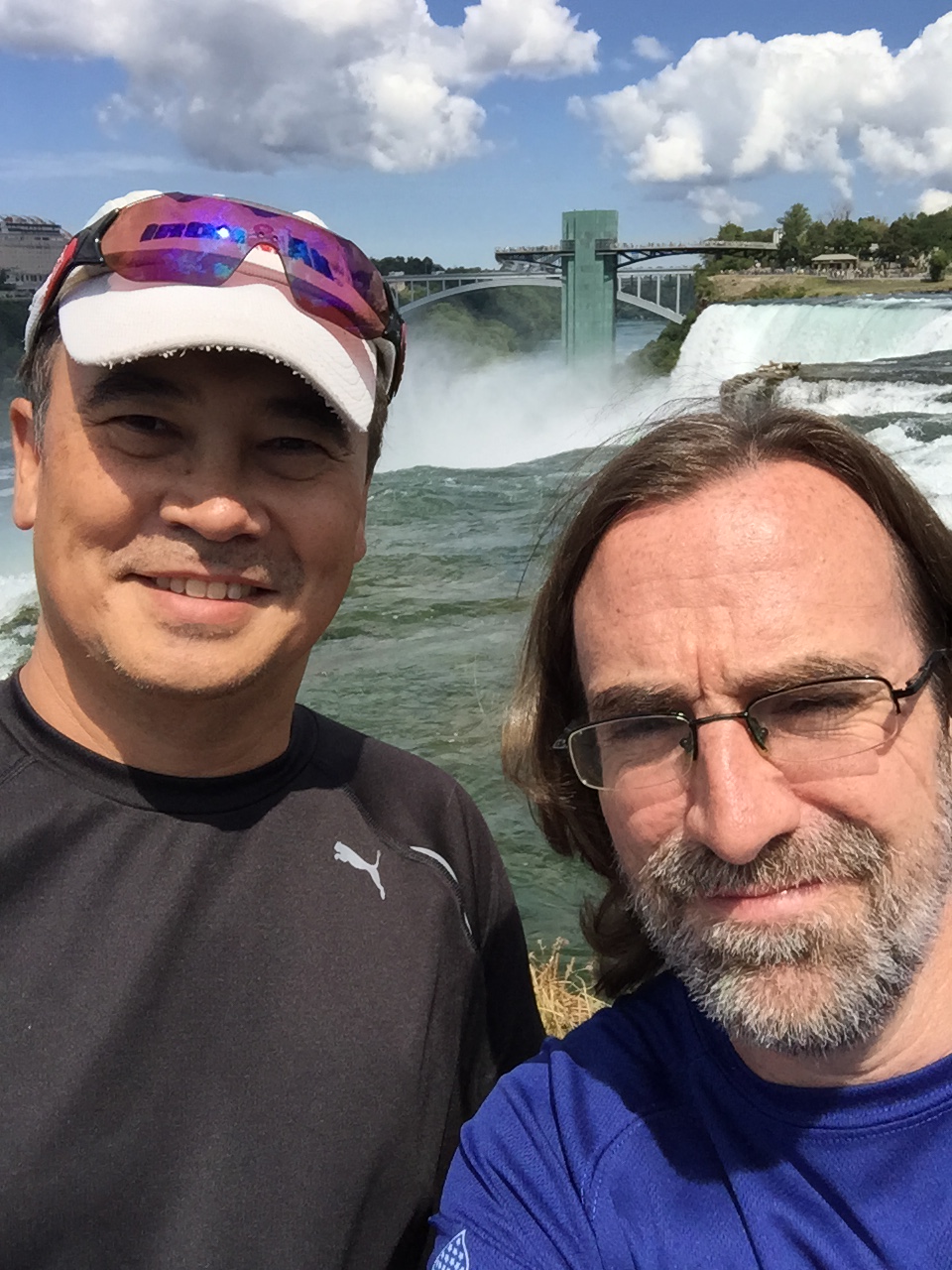
I was very fortunate to get a ride to the race from Bobby Leong, who dropped me off on his way to eastern Ohio for a family visit. He even graciously agreed to take a quick side trip to Niagara Falls (American side), since I'd never been there before! Beautiful! (Bobby also has an awesome playlist on his phone, but that's for another story.

I was also fortunate to have the hospitality of Jim and Beth Pease, who are generous without end and who were invaluable volunteers for the race.

With a 10 a.m. start on August 8, I was able to get a good, full night's sleep before the race and still have plenty of time to set up my things on a picnic table near the start. It was my first time at BoB, but everyone instantly made me feel like family. There were also a number of New Yorkers (City folk) there to help me feel at home as well. And one nice item was that the weather was looking to cooperate nicely, with projected highs in the 70s with cloud cover, and only light winds! With the cooler weather, I opted to carry only one water bottle with me, which would contain my secret special blend of sports drinks, which I was trying here for the first time. One bottle rather than two meant moving faster and slower exhaustion, and I was confident that one bottle could get me through the 7 miles to the first aid station and 5.5 to the turnaround, with refilling at the aid stations.

So off we go, and some of the 50-mile and 25-mile runners took off like a flash. I went out pretty strongly, but on the eastbound outbound stretch the breeze was against us, so I didn't want to push that too hard, but just focus on proper form and technique. I got to the turnaround at Middleport in about 1:45, a little slower than I was hoping, but good enough to keep me in the lead for the 100. With the turnaround, you could see where your fellow runners/competitors were. Previous champion, Steve Parke was close behind me, so there was no slowing down. I got back to the start in 3:31, pretty much the same split. And Steve pulled in while I was there getting food and drink.

On lap 2 Steve caught up to me again at the Gasport aid station (mile 32), so I had to keep up the pace. By now it was getting warm, still not too hot, but the sun was coming out occasionally, and I had decided to run shirtless, which I never do, but it did help keep my body temperature down. By lap 3 evening was coming on, so the shirt was coming on too. Seeing Steve as I started lap 3 it looked like I had maybe a mile on him, still way too close to let up.

I was still feeling good, no problems with the stomach or feet or legs or anything, just starting to get that soreness that sometimes happens after running 50 miles. But I continued to focus on posture, form and technique to keep  me moving smoothly and quickly and to keep my breathing strong. The drink mixture seemed to be working well for me, although I had to take a break from it for 12 miles because the taste (strawberry/punch flavor) was starting to annoy me. But when I went back to it it tasted good again. And getting liquid nutrition helped keep me from spending too much time eating at the aid stations, in fact I ate very little solid food at all, except at least some fruit at each stop, one protein bar that I munched on through the race, maybe some chips, and once or twice some grilled cheese.

Darkness fell as I pulled into the start at mile 75, about 11 1/2 hours in (9:30 p.m.). So I was happy to be keeping a consistent pace, and was hoping to get the final lap in by another four hours and get under 15:30. My real hope was to beat my friend Tommy Pyon's 2014 time of 15:16, second-fastest on the course. So with little time spent I was off again for my last lap.

Jim Pease and me at the finish
I felt comfortable still and felt like I was keeping a good pace, but it's hard for me to tell in the dark. It was also hard for me to tell who the other runners were as I met them, so I wasn't sure where Steve was, so I just kept pushing to do what I could to keep the lead. By now I was becoming familiar with the course, the landmarks along the way, so it didn't feel like just long open stretches until the aid stations came into view. That breaking the course into smaller familiar sections helped keep my mind from getting too overwhelmed. I spent very little time at the aid stations now, just kept the finish line in my mind. On I went, keeping pace as best I could, feeling like I was slowing down but not sure. I was confident I had the win but still wanted to get as good a time as I could. Only in the last three miles did I start to get hungry, and it was a pretty painful hunger. I had just a little bit of Heed left in my bottle, which helped a little, enough to get through. I'm so accustomed to fixed-time races, what a joy it is to approach an actual finish line, and in the lead!! So I finished in 15:27:06, faster on the last lap than I expected! Partly that was due to shorter aid stops. Jim pease and Bobby Leong greeted me there, I got my buckle from the RD and I sat down and got some food in my stomach. Bobby, having returned from Ohio, took care of me well. After about a half hour of rest and refueling and chatting with the RDs and aid station staff and runners who had come through on mile 75, it was time to be off, as Bobby had engagements to keep before we returned home. I was told that Steve had a little trouble and had to take more time at the 87.5 mile aid station. Little did I know that John Boser (who's barely half my age), who I'd seen running strongly all day, had passed Steve and was close to finishing, in just 16:08 for second place.

Me and Bobby Leong at the finish
So that was the race, but there was also the run, the many great things that made the experience truly enjoyable, starting with the people. The other runners, the aid station volunteers were all so great and supportive. I don't chat much when I race, so I couldn't really express how appreciative I was of their kind words and support!

There was also the beauty of the course, the smooth canal and the woods alongside, with occasional houses or small towns along the way. It was especially beautiful as sunset came, and the sky cleared up to give bright colors to the landscape. And at night the occasional fog off the water added an eerie touch which was nice. It was nice to see stars, too, which actually helped me run, as I sometimes tend to slouch when I get tired which hampers my breathing. Looking up at the stars kept my head up and my chest open to aid in my breathing and my form. Plus i saw one shooting star, and I kept looking for more!

So I owe a big thanks again to Bobby, and to Jim and his wife Beth, to the RDs and their staff and volunteers, and to all the other runners, not just at BoB, but all those in the NY ultra community who inspire me and help make me want to be the best I can be.

Sunday, December 29, 2013

Race Report: Brooklyn Marathon

This report is also a couple of months late, but at least it has a happier ending than my last.

Over the summer and fall I had been coaching a good friend from El Paso to run the new York Marathon, his first marathon, and through his experiences I felt a new excitement for the race, as if it were my first marathon again. (My first marathon was the New York Marathon in 1997.) He did very well in the race, I had a lot of friends who ran, either on their own or as pacers or Achilles guides, so I was inspired to sign up for the Brooklyn Marathon on Nov. 17. This would also be my first marathon since Boston 2011, which happens to be my PR at 2:50:55. I'd been wanting desperately to run another marathon but couldn't find on nearby on the calendar that I could run, until Brooklyn. I was also looking to re-qualify for Boston, but this would be too late to enter for 2014. Still, I was ready to go.

This relatively new race, put on by NYC Runs, was run entirely in Prospect Park. According to the web site the course was two loops around the lower end of the park (about two miles each), then 6 full loops (about 3.3 miles each), followed by another lower loop. It might have been confusing for some people, but the logic was there, and there were signs marking each mile, so it wasn't tough to follow. I was very familiar with Prospect Park, since I trained there a lot when I lived in Brooklyn years ago. I figured the big hill leading up to Long Meadow could be tough after a few repeats, but then again there was an equal downhill on the other side.

At the start it felt like a very fun, low-key race, almost old-fashioned, with not too many runners (about 400-500 in the end), no corrals, and in informal chat before the race with some of the expected leaders about staying in the designated lanes of the park road. The park was fully open to the public, but avoiding casual parkgoers was seldom a problem of any kind. The weather felt good, warm for mid-November and overcast, so it promised to be a good time.

I didn't have a firm goal, except to qualify for Boston, but I was hoping to get in under 3:00. I started out at a good pace for that goal, a little fast actually, but that first mile is mostly downhill. I chatted a little bit with a young guy, just graduated from college, who was running his first marathon, and hoping to get under 3:00 as well. We ran together basically for the two short loops and then some before he pulled away. I'm so accustomed to running ultras on loops even shorter than this that the multiple-loop format didn't bother me. There was water and Gatorade at either side of the park, so aid was good. I hit the half marathon mark in about 1:28, so I was still on track for a sub-three, but I'd have to keep pushing. Surprisingly, the big hill didn't seem to bother me as the race went along, in fact it felt like it got shorter, even if it did slow me down a little. My back did start to hurt me after about eight or nine miles, my feet started hurting after about 10, and that rain came down in the second half, but I kept pushing through. With about two miles to go, starting the final short loop, I spotted the young rookie who'd pulled away from me early in the race, and I was slowly catching up to him. So I had to motivating factors, catching him, and getting in under three hours. I was not quite able to catch the guy, but I did get in under three hours, with 2:59:03, good for 11th place, and first in the over-40 age group.

After my disaster at 24 The Hard Way, I needed a good race, so this felt very good. And I was reassured that I still have some speed left. And it was a fun race, a nice community atmosphere, well done by NYC Runs. They are trying to get permission to put the marathon on the streets of Brooklyn, but I really like the loop course in Prospect Park and the small field. This is one I might come back for in 2014.

Race Report: 24 The Hard Way

OK, so this post is two months overdue. It's tough to write about the races that don't go well. And this one didn't go well, despite the great hospitality by race director Chisholm Deupree, the incredible organization and staffing of the event.

The race took place on October 26 in Oklahoma City. I arrived the day before and Chisholm showed me the course. The loop was through a park, just short of a mile, and my early take on it looked like a good course to me. There were some little ups and downs, but nothing too strenuous. I also had the good fortune to meet lots of my good friends before race day, which is one of the real special aspects of the national championship 24-hour race.

Generally, I hadn't raced much over the summer or fall so I wasn't really sure what kind of shape I was in or what I might be capable of, so I didn't want to put to much pressure on myself to get a certain mileage. I would just try this one by feel. Looking at the registered entrants, Mike Morton definitely was someone who could beat me for the national championship, but he was still dealing with an injury and didn't come to Oklahoma. Brian Teason also looked like a possible contender, but it seemed like I had a good shot at a win and a third national championship, so I was optimistic.

Things started out well, I settled into what felt like a comfortable pace. After a few hours we had some rain, which never got very heavy, but it dissipated by early evening. There were some technical issues with the timing system that failed to record some runners' laps. I was keeping track of my laps, and the counter was always correct for me, but I wasn't sure about who was ahead of me. Brian always seemed to be just ahead of me, or just behind me, but never more than a lap. I was told there was another runner ahead of me, but no one seemed to tell me who it was or how far ahead. I admit that this uncertainty got on my mind a little too much.

Still, I hit 50 miles in about 7:30 - 7:40. I've definitely had faster 50-mile splits, even though this pretty much matched my split from the 2007 world championship in Drummondville, Quebec, which is still my PR. So I didn't worry too much. In that race, my 12-hour splits were about 80 and 74, so I made it my goal to try to get 80 miles again in 12 hours. That 4 - 4 1/2 hours I pushed pretty hard to hit 80 miles, and maybe pushed too hard, without eating enough, and without realizing it I was probably digging myself into a hole. I did hit the 80 mile split just after the 12 hour mark, and I let myself rest a little after that, by taking a couple of easier laps, incorporating more walking, and more eating. But for some reason, I just couldn't get running again. No matter what I tried to get my energy up, all I could do was walk. I still have no real explanation except that my head just didn't feel connected to my body, and I was in a mental place where I just couldn't get myself running again. I'd run for short stretches but that was it. I basically ended up walking most of the last 12 hours, and finishing with just 117.54 miles. The race was won by John Cash, who was leading pretty much the entire race, with 140.41 miles, 2nd was Nelson Armstrong (in sandals) with 138.48 and third was Dave Ploskonka with 134.3. I ended up 11th overall, 9th male, and 7th USATF male. Connie Gardner won the women's race with 132.71, Katalin Nagy 2nd (but not USATF member) with 124.06 and Cherie Yanek 3rd with 115.59.

It's extremely frustrating to me still because it's a race I could've won, and there was no real reason for me to struggle so much. All I can think is that I was just not ready to race. I just hope I can at some point find something to learn from it, other than that you can't force yourself to be motivated.


Friday, September 27, 2013

International Disposal Day

I am hereby declaring that today, Friday, September 27, is International Disposal Day (with apologies to my European friends for whom the day is half over, and my Japanese and Australian friends for whom it is already Saturday).

Today everyone must throw something away, particularly something you've been neglecting to throw away. It could be something minor an literal, like those tomatoes that have been in your fridge just a few months too long, or the stack of newspapers and magazines you need to tie up and take to recycling (recycling counts, too). It could be that box of souvenirs that really has no sentimental value, even after 20 years, or maybe that box of cassette tapes when you haven't had a working cassette player in 10 years.

Or it could be something else, like maybe canceling a subscription that's been a waste of time and money, or making this the first day to stop a bad habit. Or it could be even deeper, like ridding yourself of a negative influence, something (or even someone) that's been weighing you down.

My only two rules are: it can't be regular taking out the trash - it has to be something you've been meaning to get rid of for some time; it can't be too symbolic - you have to actually do something.

For me it will probably be a little of all of the above. But try it. You might be surprised at how good it feels!

Sunday, August 18, 2013

Race Report: BUS Pajama Romp 6-Hour

The Pajama Romp 6-Hour race has quickly become a favorite in the New York ultrarunning scene. It's a 6-hour race on a loop of just over 1.25 mile in beautiful Astoria Park, Queens, right on the water with views of Wards Island, and underneath the Triboro Bridge and Hell gate Bridge. It took place in the evening, from 5:00-11:00 pm, away from the worst of the summer heat. The 2013 edition was on Saturday, July 27 with excellent weather conditions, unlike the stifling heat of 2011 and the rain of 2012.

I had come into the race undertrained but was hoping for a good showing nonetheless. As with all race reports that don't have a happy ending, this one begins with, "I started out way too fast." Tommy Pyon and Aaron Heath took off like a shot, and although I didn't try to keep up with them, they motivated me to run faster than I should have! But that wasn't where my main problem was. After a couple of hours, solidly in third place and on point for a good mileage, my back pain reared its ugly head and forced me to slow down, even walking large chunks of some laps. Striding out just aggravated my back, so the running I did wasn't at a good speed. The pain came and went, but my legs had stiffened up so much that it was hard to get anything going. But I kept on, enjoying the company of the other runners, enjoying the beautiful evening.

In the end, I finished in eighth place for the men with 38.34 miles. Aaron beat out Tommy for the win, and Sky Canaves won the women's race convincingly. It was a great occasion to get together with runner friends, and to make new friends. One nice thing that stood out here is the number of talented young ultrarunners in the NYC area. There were a lot of new faces here, and they showed a promising future to continue the great tradition of ultrarunning in New York!

Wednesday, August 14, 2013

Race Report: Queens 10K

The Queens 10K is part of NYRR's 5-borough race series, which used to be a 5-borough half marathon series. The Queens Half Marathon was held for many years on the streets of College Point, which is a very nice neighborhood, but I think the residents there were tired of having streets closed off for a few hours one day a year, and I know a lot of runners weren't crazy about the trip out there. I myself once had to jog the three miles from the Flushing subway station to the start because there wasn't enough time to wait for a shuttle bus or a public bus. Eventually they moved the course chiefly onto park roads in Flushing Meadows Corona Park along with a long out-and-back on College Point Blvd. So the current 10K course largely follows that course, minus the section on College Point Blvd.

The race was held on July 21, and the weather was warm and very nice. It was my first NYRR race since the team championships in August 2012. It felt good to get out and do a fast race again. It was over in no time, there's not a lot to report on the race itself. I didn't run quite as fast as I hoped I would, but I'm happy with my 38:13, which was good enough for 2nd in my new age group, men 45-49. And I passed a lot of runners in the second half of the race, so that's a good sign for my pacing.

So I left the park exhausted but content. And it was just the first of three race weekends in a row, so more to follow!

Thursday, August 8, 2013

Race Report: The Great New York 100 Mile/100 KM Running Exposition

This post is better late than never! The second, some people are saying "annual," Great New York 100 Mile Running Exposition, managed to come off on June 29, on a hot, sticky day. The race had the same small, low-key, under-the-radar atmosphere of the first, but it was just a little bit larger, higher-key and on-the-radar. And what was a scrappy first effort became a better organized second running.

The course was the same, except for some small deviations, most notably the loss of the Rockaway Beach boardwalk from hurricane Sandy last fall. It still started in Times Square at 5 a.m. on a Saturday, and featured most of the city's best running routes, including greenways, park pathways, forest trails, beaches and bridges, as well as city streets - residential, commercial and industrial, before finishing back in Times Square. It roughly skirts the outer boundaries of Manhattan, the Bronx, Queens and Brooklyn. (Staten Island is not on the route only because there is no way to get there on foot without going through New Jersey.) The idea of the race is to showcase the great places in the city to run that the city's runners might not otherwise know about, and I hope that it has accomplished that goal.

The main differences between last year and this is that I increased the field size from about 30 to what became 60 registered runners, I gave an option for a 100 km finish, added aid stations so that they would be spaced about every five miles. Another huge difference was the help of Trishul Cherns, who did an amazing job recruiting and organizing the volunteers, who all performed like rock stars! It was largely this help that kept the race running as smoothly as it did, and brought the New York ultrarunning community together.

I also tried a different course marking system this year, using yellow flagging tape, similar to trail ultras, but tied to parking sign poles, street light poles, etc., with little yellow cards with arrows taped to poles at turns, all of which I thought would be more visible. Last year I spray-painted yellow arrows on the ground, but I don't like the idea of spray-painting the city, it feels like graffiti or vandalism to me. But many of the arrows were still visible to give the runners some extra help in finding the course. Both last year and this I heard numerous reports of runners going off course. To some degree that might be inevitable, but nevertheless there is still some work to do devising a better marking system.

The runners this year were again mostly from the New York metro area, but there were several from far away, including our first two international runners, Juergen Englerth from Germany and Thomas Alm from Sweden. Juergen was among the 100 mile finishers, and Thomas finished the 100 km.

Our intrepid journeyers gathered in the relatively quiet (except for the jackhammers of adjacent construction) Times Square at the TKTS booth at 47th and Broadway starting at about 4 a.m. Tshirts and wristbands were distributed, drop bags dropped off, and last-minute instructions given. At 5 am after a beautiful National Anthem sung by Anna Uzzell Harreveld, the runners were off.

Eliot Lee once again provided invaluable help as supply chief, driving me to each aid station to drop off water and Gatorade (we again had Gatorade donated by Dennis Ball). Nick Palazzo was again our sweep vehicle, picking up leftover water and Gatorade after the last runners passed through the aid stations. So Eliot and I kept ahead of the runners for most of the race, which was necessary, but unfortunate that we wouldn't get to see them during their struggles. I only received the notifications, as the afternoon grew increasingly hot and humid, of the runners who chose to stop early after 30, 40 or 50 miles. But I did get to meet the incredible volunteers who had shown up, in many cases bringing food, ice or supplies of their own for the runners, and creating nice little oases on a hot day.

One indication that the race was a little higher-key and on-the-radar was that we had attracted the attention of a journalist from the Wall Street Journal, who emailed me a few days before the race. I was nervous about drawing attention, and I had no time really to speak with her anyway, but from the web site, the facebook page, one email from me and conversations with previous runners Keila Merino and Chris Solarz, she put together an article for the weekend edition on Saturday that Eliot showed me on his phone as we drove from aid station to aid station. I have to say, I really liked how it came out, and figured that by coming out on Saturday it would be too late for any nosy city or parks official to cause any trouble.

As the day wore on I did, however, come to realize one really stupid mistake on my part that made the run tougher for some runners. In the printed directions that I handed out at the start, which was four pages long, I realized while supplying the World's Fair Marina aid station that pages two and four were missing! Trishul's wife Kaaren had alerted me to the missing p.4 and said that she would make copies to give out at the 100K aid station, but p.2 covered miles 28-58, and most of the runners were in that zone at that moment. Some runners had the full set of directions, but many did not, and the route was hard enough to follow just from the markings. I decided the best plan would be to find someplace to make copies of the missing page and distribute them at the aid stations between miles 28 and 58. So Eliot and I found a Staples near the Astoria aid station, made the copies and drove back to the Bronx at Sound View Park, gave some to Nick to drive to World's Fair Marina, and we then made our way to Little Bay Park to continue supplying. This put us a little behind the lead runner, Tommy Pyon, but we eventually made up time, and fortunately Ravi Misra at Little Bay Park had some water already to give him before we got there.

But on we went. Trishul and Kaaren had a nice area set up at the exit from Forest Park for the 100 km aid station, and finish line for 100 km runners. 100 mile entrants were also allowed to stop there for a 100 km finish, and a number of them took advantage. A few continued on for a few more miles but decided that a 100 km finish was good enough. 100 mile runners were given 16 hours to reach 100 km if they wanted to continue on, but all were allowed 18 hours to receive a 100 km finish place and certificate.

So eventually Eliot and I arrive at the finish line to await Tommy, who is still in the lead. A number of his supporters were there, as well as many Times Square tourists, this being just after midnight on a hot Saturday night. But to my surprise there was also a group of tourists from Ontario who read about the race in the Wall Street Journal and came to Times Square specifically to see the winner come through, which he did soon after, in 19:36:55. One of them even took a picture with Tommy holding his baby!

We had 21 finishers for the 100-mile run and another 22 in the 100 km. I'm very proud of all of them, including those who didn't get to 100K. The one thing that suprised me the most about being a race director is how personally I take their successes and their struggles.

So I don't have room here to name all the great volunteers who made the race a success, but I have to give special thanks to Trishul and Kaaren, Eliot and Nick, as well as Rich Innamorato for loaning me his storage unit in Long Island City, Dennis Ball for more Gatorade donations, Joe Del Conte, who took on I think three or four volunteer duties, and Annette Vega who with Joe helped the later runners through the night.

What happens next year is hard to say, but I certainly hope to put something great together!!

Friday, May 3, 2013

Race Report: Sri Chinmoy Self-Transcendence 6-Day Race; or, How I Stopped Worrying About the Race and Learned to Love the Run, Part II

Numbers of all kinds were running through my head before the start of the Sri Chinmoy Self-Transcendence 6-Day Race, which started April 21, 2013 in Flushing Meadows Corona Park, Queens. I had high hopes for big mileage totals, so those numbers were in my head, as well as my expected mileage per day, minutes per mile, hours I'd have to sleep, etc. But before the end of the race, none of those numbers really mattered at all, and the most important number was the huge number of friends who came out to crew for me, bring me food, or cheer me on.

So right off the bat I want to thank those people: Trishul and Kaaren Schilke-Cherns for their advice and for the use of their tent, Mike Arnstein for driving me to the start and crewing for me in the early hours, Otto Lam and Paul Kentor for helping crew at the beginning also, Shaun Leonardo for crewing overnight Monday night, Oz Pearlman for crewing Tuesday afternoon/evening and for the "inspirational" notes, Enrico and Sonam Curreri for their visit Tuesday, Deanna Culbreath for crewing Wednesday morning, Rick McNulty also Wednesday morning, Al Prawda for the afternoon, Cherie Yanek for later Wednesday, Richie Innamorato for coming by a couple of times, Susie Schmeltzer, Gerald and Donna Tabios, Mat and Lucinda Gerowitz, Shishaldin Hanlen, Glen Redpath with Pavel and Corinne, Keila Merino (twice) and Stephen England, Mike Mazzone, Otto again for the huge job of crewing for me Thursday night to the Saturday finish, and Elaine Acosta and Dennis Ball for coming to the finish and helping pack up my stuff, and John Garlepp and Barbara Saldick for the ride home. That doesn't even count the race directors, the race staff, especially the kitchen staff, Yuri and Arpan and Trishul and everyone in the medical tent, the musicians, the photographers, Utpal for the interviews, and the other runners who showed all kinds of love and support.
 
Phil and Sylvie Boisvert
I had a lot of reasons to feel good going into this race. Physically I felt good and well-trained and well-rested; this would by far be my longest race, my previous longest being a 48-hour race, but I seemed to do better the longer the race; this would be a reunion of sorts of the 2007 24-Hour world championship team at Drummondville, Canada, where I had my first real breakout race, with teammates Alex Swenson and John Geesler both running, as well as Canadian Sylvie Boisvert who won the open race in Drummondville, and even the race director in Drummondville, Michel Gouin.

With Mike Arnstein's help I got off to a good fast start, just as I was expecting, running 70 miles in the first 12 hours. But I realized that that pace was not sustainable, and my plans would have to be adjusted somewhat, even sleeping the first night, which I didn't plan to do. By nighttime I was on my own, and it was tough mentally, knowing how far I still had to go. It was then that I really questioned the wisdom of entering the race. But I got in about 45 minutes of sleep, from 1:45-2:30 a.m. and I managed to finish the first day with 120 miles. Monday afternoon, Mike and Oz came running by, literally, to give their encouragement and to check up on me, and to leave little notes among all my things, even in my tent.

Monday night Shaun came to crew for me, and although not a runner himself, he is a lifelong athlete, and was  an incredible handler, knowing just what I needed, even helping me into the medical tent for some early blister work, achilles work and massage. After just two hours sleep I was up again and on the road.
Me running on the last day
By Tuesday I was developing a routine of eating, drinking, sleeping, going to the bathroom, and chatting with the other runners, and worrying less about mileage. I seemed to run best from 6 a.m. to 6 p.m. We were fed good full meals at 6 a.m., noon and 6 p.m., and I usually loaded up a tray and walked with it, and usually felt a burst of energy after the calorie intake. By darkness, I usually slowed down some, and would do a cool-down lap or two before going to sleep, which nights 3-5 was about 11:00 - 3:00. The one thing I was surprised at was that I had a very hard time getting to sleep after the first couple nights. But I'd lay there and get whatever rest I could.

I've already thanked those who came by to help out, but by Tuesday and Wednesday it really became quite overwhelming, in a good way. By Wednesday I think I was gaining a reputation of having a lot of groupies come by, at least that's what Alex said! It was pretty amazing, and I hardly knew how to wrap my mind around it. But that's how I had my revelation. Before the race I'd asked for advice from Trishul, Dave Luljak, as well as from Martin Fryer and John Geesler during the race, and the one thing they all said was to just keep moving forward and not worry about the mileage but just let yourself get into the "flow" of the race. I kind of knew what they meant, but I resisted the part about not worrying about mileage, and it wasn't until Thursday night that I really felt what they meant. I had a visit from one friend who is a very good friend, but my conversation with him kind of jolted me out of the world I was in and brought in some negative outside attitudes. Otto arrived about the same time, and his enthusiasm jolted me a little as well, since I was in a pretty calm and relaxed state by that time. I actually felt the need to calm him down, saying nothing is that urgent. Then I was talking with him, trying to make sure he was going to be ok with enough food and rest, and he kept saying, "Don't worry about me. Just focus." I told him, "Focus isn't the right word. I'm just here, and this is what I'm doing. And now I get it." And at about 8:00 p.m. Thursday night, I got it. Amid the repetitive routine of eating, drinking, sleeping, peeing, and having briefly been jolted out of it, I suddenly realized I'd found the "flow," or possibly, the "bliss," and I understood the joy of what I was doing. As darkness began to fall I passed people walking, and I realized it was the same joy whether you're running or walking, and all of us were sharing the same experience.

I had been in a conversation with Nirbhasa Magee, and Irish runner in the 10-day. He's a very sweet and enthusiastic young guy and he mentioned how everything around us - the Long Island Expressway, the lake, the kids, the motorcyclists popping wheelies, the seagulls pulling worms out of the ground at dawn - was our environment, our theater that we were moving through.


Pavel, Corinne and Glen
So Thursday night turned into Friday, and at Friday noon I felt a big rush of energy from four sources: 1. The sun (and the weather was really beautiful pretty much the whole time, no rain, only occasionally some strong winds); 2. My handler Otto; 3. Lunch; 4. The knowledge that I only had 24 hours to go. Now with my legs still relatively strong, my feet feeling trashed but mostly numb, and newfound energy I began a long surge that took me from 391 miles at noon to 400 miles shortly after 2:00 p.m. and beyond. I did the calculations, and determined that if I kept the same pace (a little better than 4.5 mph) I could just reach 109 for the last day and 500 for the race! It's not a fast pace, and it felt comfortable, but as time went on it felt more and more like a sprint. Otto crewed me like a champ, having everything I needed ready for me. But by a little after 7:00 p.m., the wind came up off the lake, and I realized the foolishness of the task, and I fell into a walk. I thought, I want to enjoy the last day rather than push myself for an arbitrary goal. All I had to do was keep moving and I would win the men's race with a good total, and I would get much more out of the experience.
Martin Fryer of Australia and Kaneenika Janakova of Slovakia, 10-day winners; me and Diplai Cunningham of Australia/U.S., 6-day winners
 The most magical moment of the race came early Saturday morning, about 3:00 a.m. There had been musicians playing during the race - electric guitar/drums, saxophone, acoustic guitar. Saturday morning an electric guitarist was playing eastern-style riffs on the plaza by the lake at the concession stand building, amid the still night sky under a bright full moon, accompanied by a low electric drone. The absolute peace of the moment was only broken by my own traveling around the course.

So after several more hours of traveling around the course, the race was coming to a close. In the end, I won the 6-day race with 462 miles, the great Dipali Cunningham won the women's 6-day race for the 16th straight year. Martin Fryer, my Australian friend, won the men's 10-day and Kaneenika Janakova of Slovakia won the women's 10-day. I was very proud to have finally met Dipali and had the chance to talk with her periodically during the race, and she very kindly gave me words of encouragement. My proudest moment came at the finish when she came over to congratulate me and told me how I helped pull her through the last day. She is truly one of the all-time greatest ultrarunners in the world, and yet one of the most gentle and humble. Early in the race John Geesler had told me that he hoped that he, Alex and I would finish 1, 2, 3, and we did, with Alex and John both finishing with 409 miles (Alex took the 2nd spot by reaching the distance first).

John and me
Alex, me and John
 Now, several days after the race, I am beginning to understand how it fits into my running career and into my life. Over the last year, after some bad races, I've begun to reevaluate my running and my motivations. I'm taking a more personal approach, a more philosophical approach, trying to understand how this fits into my own personal fulfillment, rather than how this fits into the local or national or world scene, or trying to prove to people what I can do. I realize that I have a lot of supporters who want me to do well, but I think I can be a better positive influence by taking this approach. This really only touches the surface of the events and thoughts on the race, and the lessons I learned and the people I met. Some things will have to remain my own personal experience. The "Part II" in the title refers to the Febapple 50 Mile race in February, which was Part I. There I finished a tough race much slower than expected but with as much satisfaction as if I'd won, and maybe more, because it was a victory in its own way. The Self-Transcendence 6-Day Race was a victory as well because I rediscovered the joy of running, of dissipating stress, of coexistence, of relaxation, of smiling and laughing, of showing a positive image, of learning gratitude.
Me and Dipali after the race
Otto, me and Elaine after the race